Physical Address
381 Myrtle Avenue, Brooklyn, NY 11205
Physical Address
381 Myrtle Avenue, Brooklyn, NY 11205

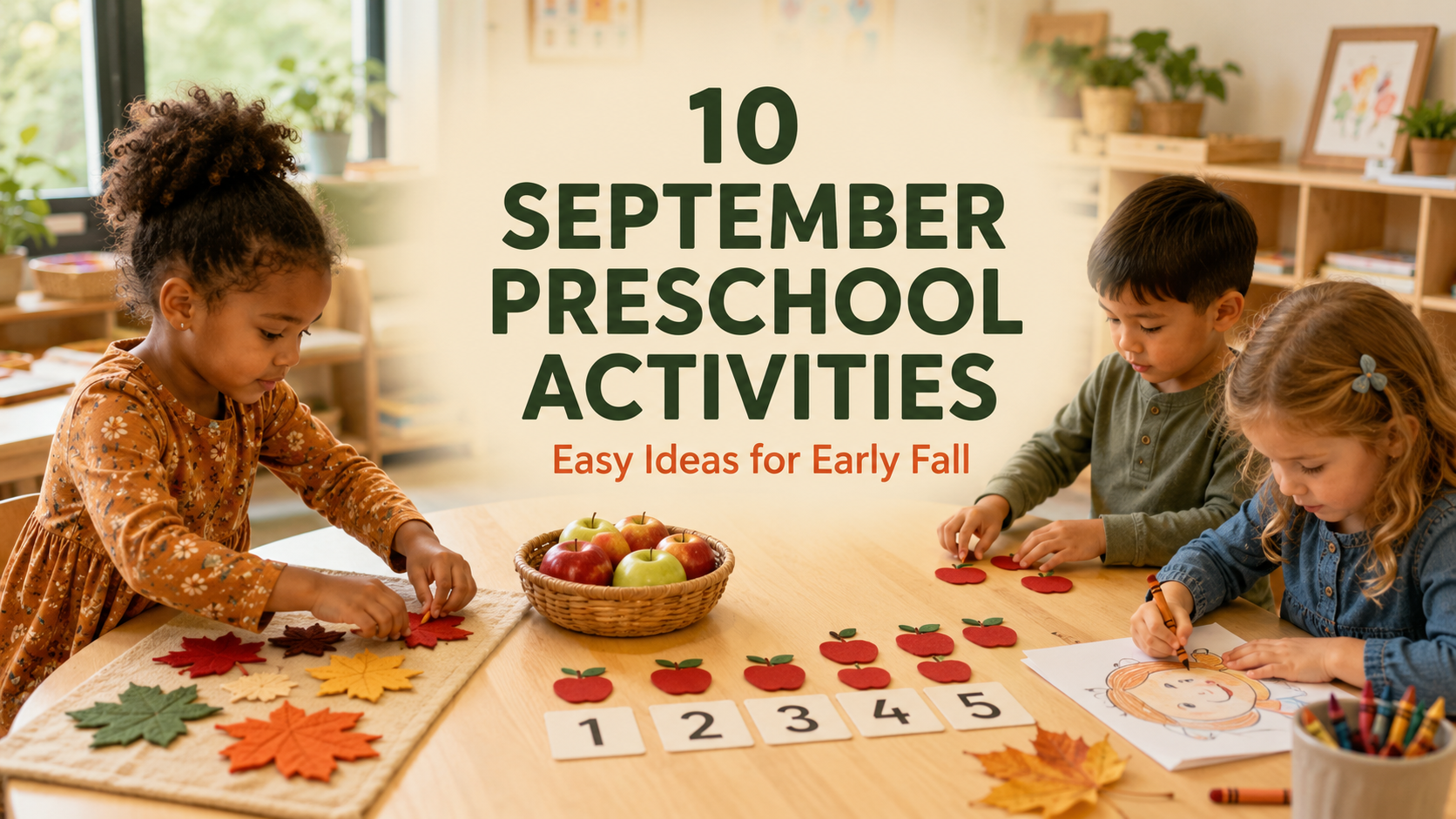
September brings a season of new beginnings for preschoolers. Some children are entering a classroom for the first time, while others are returning to familiar routines after summer. The weather is beginning to change, apples are in season, and small signs of fall are appearing outdoors.
The best September preschool activities help children settle into their environment while making room for creativity, movement, conversation, and hands-on discovery.
These ten easy ideas work well in preschool classrooms, daycare programs, and at home. They include early literacy, math, art, sensory play, school routines, self-awareness, and outdoor observation without turning the entire month into one long apple craft.
An “All About Me” portrait gives children an opportunity to think about their appearance and share what makes them unique. Provide a mirror and invite each child to study their face before creating a self-portrait.
Rather than expecting a realistic picture, talk about what the child notices. Ask questions such as, “What color is your hair?” or “What expression would you like your portrait to show?”
Write the child’s name and one thing they want classmates to know about them beneath the finished picture.
Materials:
Developmental focus: Self-awareness, identity, vocabulary, observation, fine-motor control, and creative expression.
Display the portraits at children’s eye level to help the classroom feel like a place where everyone belongs.
New classroom expectations can feel overwhelming when they are only explained verbally. Turn common routines into a simple picture-sequencing activity.
Create cards showing steps such as hanging up a backpack, washing hands, choosing a learning center, cleaning up, and joining circle time. Review the cards together and let children place them in the correct order.
You can also invite children to act out each step.
Materials:
Developmental focus: Sequencing, memory, independence, listening, and understanding daily routines.
This is one of the most useful back-to-school preschool activities because it teaches expectations without relying on repeated correction. Families preparing for a new program may also find our first week of preschool guide helpful.
Bring in red, green, and yellow apple varieties for a simple taste test. Let children look at, smell, and taste a small piece of each apple before choosing their favorite.
Record every vote on a picture graph. Count the votes together and compare the columns using words such as more, fewer, and same.
Children should never be pressured to taste unfamiliar food. They can participate by smelling, touching, or observing the apples.
Materials:
Developmental focus: Counting, comparison, descriptive language, decision-making, and early data representation.
Check for allergies and dietary restrictions before serving food. Prepare apple pieces in an age-appropriate form and supervise children while eating.
For more seasonal ideas, explore these apple-themed preschool activities.
Names are meaningful first words for preschoolers. Write each child’s name clearly on a card, then provide individual letter cards that match it.
Children can place the letters over the written model or arrange them underneath. Younger children may begin with the first letter of their name, while older preschoolers can work on arranging every letter in order.
Materials:
Developmental focus: Name recognition, letter identification, visual matching, sequencing, and early literacy.
Avoid turning the activity into a spelling test. Model the letters, say the child’s name slowly, and offer only the letters needed at first.
Take a short walk around the playground, yard, or neighborhood and look for safe natural materials that reflect the changing season. Children may find fallen leaves, small twigs, dry grass, flower petals, or pieces of bark.
Back inside, arrange the materials on sturdy paper to create an open-ended collage. Children can describe the colors, textures, and shapes of the items they collected.
Materials:
Developmental focus: Sensory observation, classification, vocabulary, fine-motor skills, and creative decision-making.
Check all materials before children handle them. Avoid unknown berries, mushrooms, sharp objects, animal waste, and plants that may irritate the skin.
This activity fits naturally into many preschool September themes, including seasons, weather, trees, and neighborhood exploration.
Create a sensory bin inspired by familiar classroom materials. Use shredded paper or large fabric scraps as the base, then add chunky magnetic letters, large crayons, child-safe scissors, name cards, and small notebooks.
Invite children to find certain objects, sort supplies by type, or pretend they are preparing for school.
For younger children, use only large materials that cannot fit inside the mouth.
Materials:
Developmental focus: Sensory exploration, vocabulary, sorting, fine-motor coordination, and imaginative play.
Supervise sensory play closely, especially when materials can be scattered or mouthed. If loose fillers are unsuitable for your group, place the classroom objects in an empty bin instead.
Create a large paper or felt tree and provide movable red, green, and yellow apples. Children select a number card and place the matching quantity on the tree.
As each apple is added, encourage the child to touch or move one piece for every number spoken. Begin with 1 to 3 for younger children and increase the quantities gradually.
Older preschoolers can sort the apples by color, compare two trees, or combine two groups for simple addition.
Materials:
Developmental focus: Number recognition, counting, one-to-one correspondence, sorting, and comparison.
Our easy apple counting activity for preschoolers provides detailed adaptations for children ages 2, 3, 4, and 5.
Place red, orange, yellow, green, and brown paint at the art table. Instead of giving children a model to copy, invite them to create a picture showing what September feels or looks like to them.
Some children may paint trees and leaves. Others may make lines, swirls, color mixtures, or abstract marks. Talk about their choices without deciding what the artwork represents for them.
Materials:
Developmental focus: Creative expression, color exploration, hand-eye coordination, decision-making, and language.
Ask open questions such as, “Tell me about the colors you chose” rather than asking, “What is it?”
Choose a familiar outdoor route and invite children to look for small signs of seasonal change. They might notice cooler air, different shadows, fallen leaves, birds, seed pods, or changes in the garden.
Give each child a simple picture checklist or let them draw one thing they noticed when they return indoors. Repeat the same walk later in the month and compare the observations.
Materials:
Developmental focus: Observation, comparison, attention, vocabulary, and environmental awareness.
Keep the walk short and focused. The aim is not to find every item but to slow down and notice what is happening outside.
Among simple fall preschool activities, repeated nature walks are especially practical because they allow children to notice gradual changes instead of treating fall as something that happens overnight.
Help children learn one another’s names by creating a class book. Give each child a page containing their photograph or portrait. Ask them to complete a simple statement such as:
Write down the child’s exact words. Combine the pages into a book and place it in the classroom reading area.
Materials:
Developmental focus: Oral language, identity, name recognition, listening, and classroom connection.
Read the book during group time and allow children to revisit it independently. It can be particularly comforting during the first few weeks of school when names, faces, and routines are still becoming familiar.
You do not need to complete all ten ideas in one week. Select activities that match the children’s interests, classroom routines, ages, and current comfort levels.
A balanced September plan might include:
The strongest September activities for preschool leave room for children to participate in different ways. One child may tell a detailed story about a nature walk, while another contributes a single word or points to a picture. Both are meaningful forms of participation.
Families preparing children for group learning can also explore our preschool readiness guide, toddler developmental activities, and learning-through-play resources.
September is not only about fall decorations and perfectly finished crafts. It is an opportunity to help children become comfortable with new people, practice daily routines, express who they are, and begin noticing changes in the world around them.
These September preschool activities bring early literacy, math, art, sensory exploration, and outdoor learning into experiences children can genuinely participate in.
If you are looking for a nurturing New York daycare where children learn through purposeful, age-appropriate play, explore our preschool program or schedule a daycare tour to visit our classrooms.