Physical Address
381 Myrtle Avenue, Brooklyn, NY 11205
Physical Address
381 Myrtle Avenue, Brooklyn, NY 11205

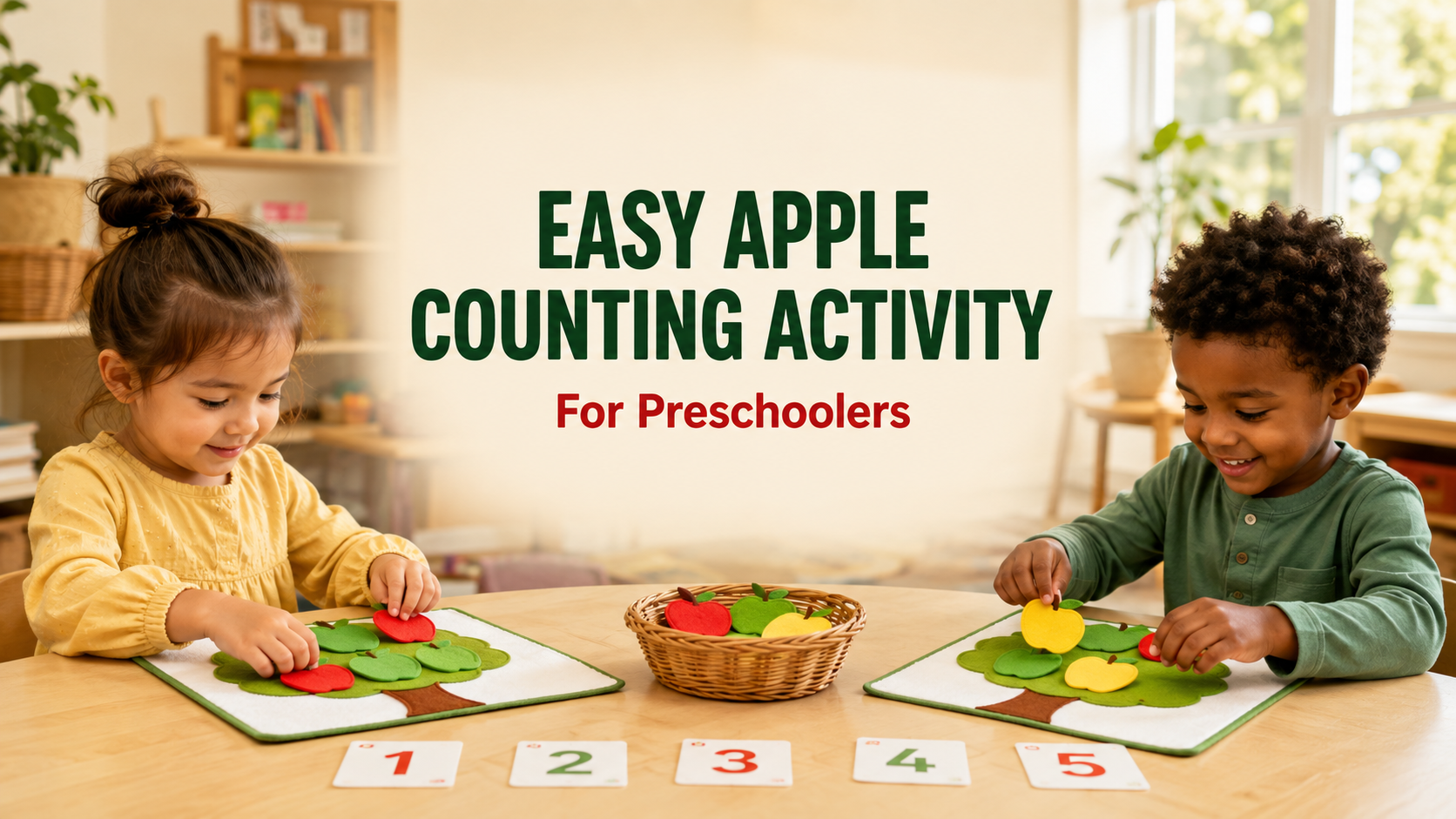
Apples are a simple way to bring hands-on math into a preschool classroom or home learning routine. Children can touch, move, sort, and count the pieces instead of completing another worksheet.
This apple counting activity for preschool uses paper apple trees and movable “apples” to introduce numbers in a playful, flexible way. The same activity can be simplified for a 2-year-old or extended into sorting and addition for children ages 4 and 5.
Children choose a numbered apple tree and place the matching number of pretend apples on it.
For example, a child who selects the number 4 counts four apples onto the tree. The adult can then ask the child to recount the apples, compare quantities, sort them by color, or combine two groups.
This makes it one of the easiest apple math activities for preschool because it can grow with the child’s current abilities.
The colored paper circles will become your movable apples. Bottle caps, large felt circles, playdough balls, or large pom-poms can also work, provided they are suitable for the children’s ages.
For younger toddlers, make the apples large enough that they cannot be swallowed.
Laminate the trees and apples if you want to reuse the activity throughout your preschool apple theme.
Begin with a small quantity so children can understand the game before more numbers are introduced.
Moving one object for each number word gives children an opportunity to practice one-to-one correspondence. NAEYC describes this as connecting one object to one number while counting and recommends modeling it by touching or moving each object in turn. NAEYC’s playful early-math guidance offers a useful example of an adult pointing to objects while recounting with a young child.
Keep the experience relaxed. If a child skips an apple or says the numbers out of sequence, simply model the process again.
Use only the numbers 1, 2, and 3.
Instead of expecting the child to recognize printed numerals, say the number and count together. Let the child place large paper apples on the tree using their hands.
You might say:
At this age, the activity can focus on handling the pieces, hearing number words, matching one apple to each spoken number, and noticing colors.
Families looking for more age-appropriate ideas can explore these hands-on apple activities for toddlers.
Begin with numbers 1 through 5.
Let the child choose a number card, name it if possible, and count the corresponding apples onto the tree. If number recognition is still emerging, show a matching dot pattern beside the numeral.
You can also introduce comparison questions:
Avoid turning every question into a test. Model the answers and count together when the child is uncertain.
Use numbers 1 through 10 and encourage children to work more independently.
After filling the trees, ask them to sort the apples by color. For example, a tree with six apples might contain two red apples, three green apples, and one yellow apple.
Children can then describe what they notice:
This combines counting, number recognition, sorting, color identification, and comparison within one activity.
Add simple number combinations.
Give the child two number cards and ask them to build both quantities. Then move the apples onto one large tree and count the total.
For example:
Keep the apples visible so the child can solve the problem by moving and counting concrete objects. NAEYC recommends using manipulable objects when introducing number composition because children can connect the written or spoken number to an actual quantity. Read NAEYC’s number-composition guidance.
Place red, yellow, and green apples in one basket. Ask children to sort them into separate bowls.
After sorting, count each group and discuss the results:
You can also sort apples by size, add leaves to some pieces, or draw dots on selected apples to create different categories.
This extension makes the activity useful for a longer unit of fall math activities for preschool without requiring an entirely new set of materials.
If the activity feels frustrating:
The goal is not to rush the child to larger numbers. Choose a level that allows meaningful participation.
When the basic activity becomes easy:
These changes keep the activity interesting without turning it into a worksheet.
Pom-poms, buttons, counters, bottle caps, and other small objects may present a choking risk. The American Academy of Pediatrics advises keeping small round objects and toy pieces away from young children. Review the AAP’s choking-prevention guidance.
For children who still place objects in their mouths, use large paper or felt apples and supervise the activity closely. If real apples are included for tasting, the CDC notes that pieces of hard raw fruit can be choking hazards and should be prepared in an age-appropriate form. See the CDC’s food choking guidance.
This apple counting activity for preschool turns basic materials into a flexible math experience. Children can practice moving one apple for every number, connecting numerals with quantities, sorting by color, comparing groups, and exploring simple addition.
It also fits naturally alongside other apple activities for preschoolers, fine-motor activities for young children, and play-based preschool counting activities.
If you are searching for a New York daycare where math is introduced through meaningful play, explore our preschool program or schedule a daycare tour to see how we make everyday learning active and engaging.