Physical Address
381 Myrtle Avenue, Brooklyn, NY 11205
Physical Address
381 Myrtle Avenue, Brooklyn, NY 11205

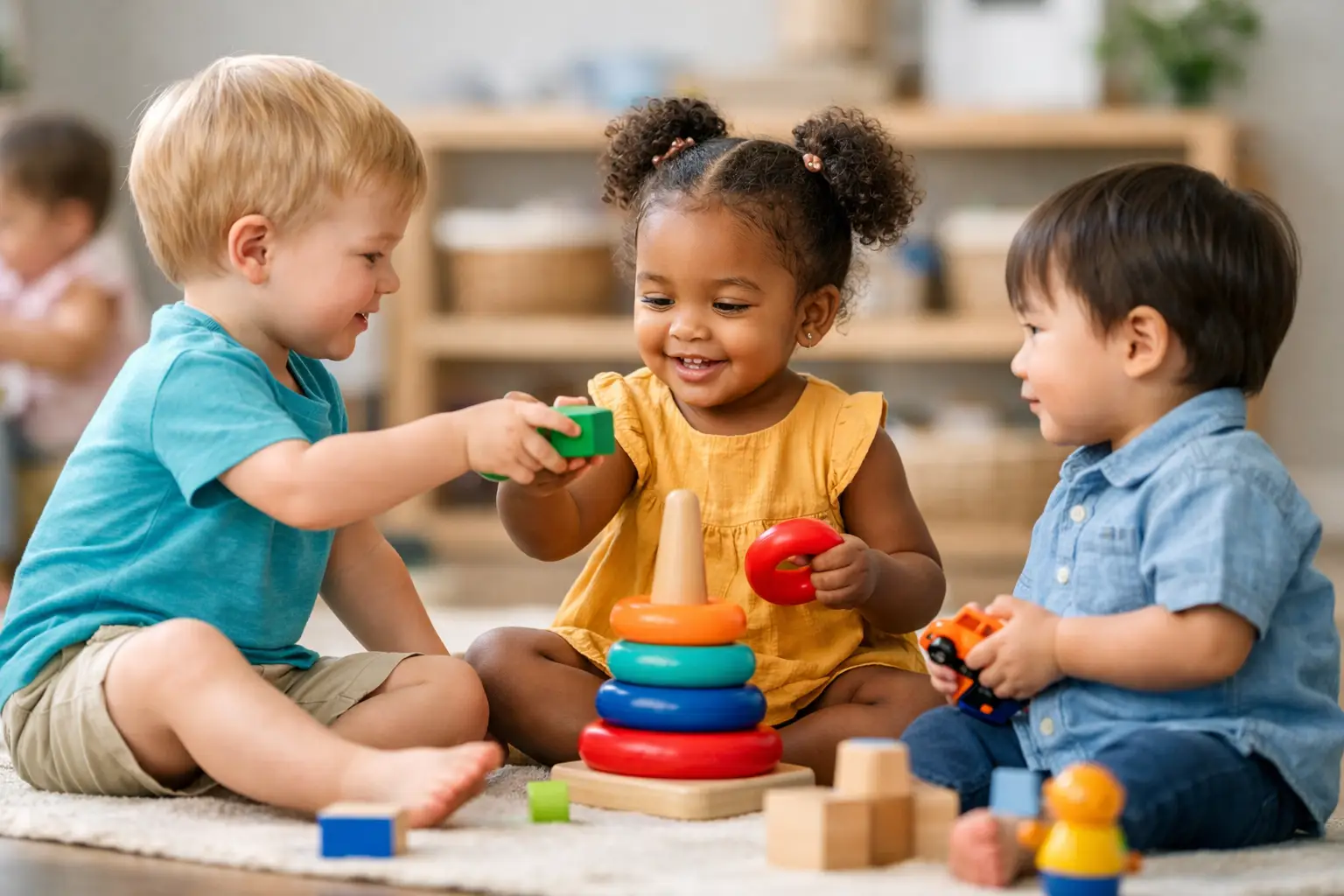
Learn how toddler social skills through play grow with patient guidance, shared routines, and joyful practice at home and in a caring classroom each day.
A toddler reaches for the red truck just as another child begins to use it. There may be a loud protest, tears, or both. This is not a sign that either child is “bad” at sharing. It is a real, age-appropriate social learning moment. Toddler social skills through play develop in these ordinary exchanges, where children can practice wanting something, waiting, communicating, and trying again with a trusted adult nearby.
For toddlers, social growth is not a lesson they can memorize. It is a process of repeated, supported experiences. Play gives children a reason to connect with others while keeping the stakes manageable. A block tower can fall. A turn can be missed. A friend can say no. With warmth and guidance, each moment becomes practice in flexibility, empathy, and confidence.
Toddlers learn with their whole bodies. They watch, touch, move, repeat, and react. Play brings all of those learning tools together. When two children roll a ball back and forth, pretend to cook in a play kitchen, or make room for one more person in a blanket fort, they are learning how relationships work.
At this age, children are often still learning to play near one another before they can consistently play together. This is called parallel play, and it is meaningful. A toddler who sits beside a peer and copies how they stack cups is paying attention, building comfort, and beginning to understand that other children have ideas worth noticing.
Over time, play creates opportunities to practice skills such as taking turns, using simple words or gestures to enter play, noticing another child’s feelings, and recovering after a disappointment. These abilities do not appear all at once. A child may offer a toy generously one day and hold it tightly the next. Growth includes both moments.
Social development can look small from the outside, but each step matters. A toddler who looks at a peer before handing them a shovel is learning connection. A child who says, “My turn,” instead of grabbing is learning communication. A child who accepts help after becoming frustrated is learning that relationships can feel safe.
“Sharing” is a big expectation for very young children. Toddlers are still developing impulse control and are often deeply attached to the object in their hands. Rather than insisting that a child give up a toy immediately, adults can help children learn the more attainable skill of taking turns.
Try language such as, “You are using the truck. Maya wants a turn when you are done,” or, “The timer will tell us when it is time to switch.” This protects the child’s feelings while showing that another person’s needs matter, too. A short turn with a preferred toy can be plenty for a toddler.
Some toys invite turn-taking more easily than others. Ramps, balls, bubbles, musical instruments, and large art projects naturally create a back-and-forth rhythm. If a favorite toy is causing repeated conflict, it can help to offer a similar option rather than framing the situation as a test of generosity.
Toddlers often know exactly what they want but do not yet have the words to explain it. When language is still emerging, grabbing, pushing, crying, or yelling can become communication. The goal is not to shame those behaviors. It is to calmly give children words, signs, or simple phrases they can use next time.
An adult might say, “You wanted the blue cup. You can say, ‘Cup, please,’” or, “You are upset because the tower fell. Let’s tell your friend, ‘Stop.’” Keep phrases short enough for a toddler to remember. Repeating the same supportive language across home and school helps it become familiar.
Pretend play is especially helpful here. Stuffed animals can ask for a turn, feel sad when a tower crashes, or need help joining a game. Children often feel more comfortable rehearsing big feelings through a toy before they can use the same language in a real interaction.
Entering a game can feel hard even for adults. For toddlers, it takes courage to approach another child, watch what is happening, and find a place in the activity. Adults can make this easier by setting up play spaces that welcome more than one child.
A large sheet of paper with crayons, a bin of scarves for dancing, or a basket of blocks creates room for shared participation. Instead of asking, “Do you want to play together?” which may be too abstract, offer a concrete bridge: “Jordan is building a road. Can you find a block for the bridge?”
Children also learn by observing respectful interactions between adults. When educators and family members greet children by name, listen patiently, and repair small misunderstandings, toddlers see what caring communication looks and sounds like.
Conflict during toddler play is expected. It does not mean play has failed. It means children have reached a moment that requires more support than they can yet provide for themselves.
When a conflict happens, begin with safety. Move close, block hitting or throwing gently, and use a calm voice. Then describe what you see without assigning blame: “You both want the same shovel. That is hard.” From there, help each child find the next step, whether that means waiting, choosing another tool, using a timer, or taking a brief break.
A rushed “Say sorry” may not teach much if a child does not understand what happened. Repair can be more meaningful when it is connected to action. A child might help rebuild a tower, bring a tissue, check whether a friend is okay, or practice a gentle touch. The lesson is not that mistakes make someone unkind. It is that we can care for one another after a hard moment.
Toddlers need adults who are available, observant, and steady. They do not need adults to direct every interaction. The balance matters: step in early when safety is at risk or emotions are escalating, but leave space for children to try a skill that is just within reach.
Narrating is one useful tool. “You noticed Eli was sad.” “You gave her a block.” “You waited while he finished.” Specific observations help children connect their actions with social outcomes. Praise is most powerful when it focuses on effort and growth rather than labels. Instead of, “You are such a good sharer,” try, “You worked hard to wait for your turn.”
Simple routines also lower the stress of social play. A predictable cleanup song, a consistent way of passing out materials, and a familiar transition before outdoor time give toddlers a sense of what comes next. When children feel secure, they have more energy for learning how to relate to others.
It is also helpful to protect unhurried play. Overscheduling, constant adult correction, or expecting every interaction to be cooperative can make social learning feel pressured. Toddlers need time to repeat favorite games, experiment with roles, and occasionally disagree. The adult’s role is to make that exploration safe and respectful.
You do not need elaborate activities to support social development. Everyday family life offers plenty of practice. Let your toddler help stir while you wait for a sibling to add an ingredient. Roll socks into a basket together. Take turns choosing a song in the car. Name the small social successes you see.
Playdates can be valuable, but short and simple often works best for toddlers. Choose an activity with movement or shared materials, plan for side-by-side play, and keep a few duplicate toys available. A successful playdate does not require children to become best friends or play cooperatively for an hour. A few calm moments near each other can be a meaningful win.
Books, dolls, and family photos can also help toddlers notice emotions. Ask gentle questions: “How does the baby look?” or “What could we do if our friend feels sad?” There is no need to quiz your child. The conversation itself builds emotional vocabulary.
Some toddlers eagerly approach new friends. Others watch closely before joining. Some use many words, while others communicate through gestures, facial expressions, or movement. Temperament, language development, sensory needs, prior experiences, and fatigue can all shape how a child engages socially on a given day.
The goal is not to make every toddler outgoing. It is to help each child build secure, workable ways to connect. A quiet child may show growing confidence by staying near a group, offering a toy, or looking to an adult for help. Those are milestones worth celebrating.
If you notice persistent concerns, such as frequent distress around peers, very limited communication, or behaviors that make play consistently unsafe, a conversation with your child’s educator or pediatrician can offer helpful perspective. Support works best when it is collaborative and free of judgment. At Growth Mindset Learning Lab, individualized observation and family communication help children receive encouragement that fits their unique developmental path.
The next time play gets messy, pause before seeing it as a problem to solve. A toddler reaching, protesting, waiting, trying a new phrase, or rebuilding after a conflict is doing meaningful work. With patient adults close by, those small moments can grow into the confidence to say, “Can I play too?”