Physical Address
381 Myrtle Avenue, Brooklyn, NY 11205
Physical Address
381 Myrtle Avenue, Brooklyn, NY 11205


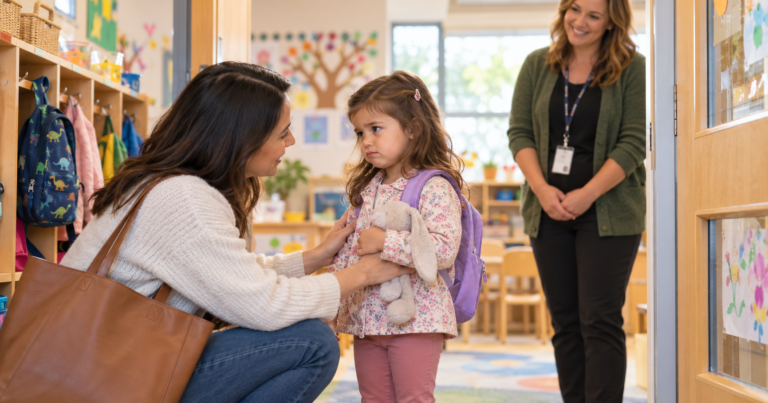
You are halfway through preschool pickup when the teacher says, “Before you go, can we talk about something we’ve been noticing?”
Then comes the part that stays in your head all evening. Your child has been hitting, refusing instructions, disrupting group time, grabbing toys, pushing other children, or having repeated meltdowns.
Even if the teacher is calm, it can feel like an alarm has gone off. You may wonder whether your child is becoming “the difficult one,” whether you missed something at home, or whether the teacher is trying to tell you there is a much bigger problem.
Before you punish your child, defend them, or start searching for a diagnosis, get specific. A preschool teacher raising a behavior concern is important information, but it is not a complete picture of your child. What matters is understanding exactly what is happening, what tends to trigger it, how often it happens, and what your child needs help doing instead.
Do not leave the conversation with only words like “aggressive,” “disruptive,” “defiant,” or “not listening.”
Those labels can make parents panic, but they do not tell you what to work on.
Ask the teacher, “Can you give me two or three examples of what you’ve been seeing?”
Then listen for details.
For example, “He is aggressive” could mean your child pushed another child twice when they tried to take a toy. “She doesn’t listen” might mean she struggles to stop playing when it is time to clean up. “He disrupts circle time” may mean he gets up repeatedly after sitting for several minutes.
Those are different problems, and they need different solutions.
Before you leave, try to understand four things: what happened, what happened just before it, how the adults responded, and what happened afterwards.
Young children’s behavior usually makes more sense when you look at when it happens.
Ask whether the problem shows up during free play, transitions, meals, circle time, bathroom breaks, nap time, or busy parts of the day.
If your child becomes upset mainly when one activity ends and another begins, the real difficulty may be transitions rather than “bad behavior.” Why toddlers struggle with daycare transitions can help explain why some children react strongly when they have to stop something they are enjoying and move on quickly.
If the behavior happens when the classroom is noisy or crowded, overstimulation may be part of the picture. If it happens when another child takes a toy, your child may not yet know what to say or do in that moment.
The aim is not to excuse the behavior. It is to understand what is setting it off.
Many parents hear a preschool concern and immediately think, “But my child never does that at home.”
That matters, but it does not mean the teacher is wrong.
Preschool asks children to do things home may not. They have to share adult attention, wait longer, follow a group routine, manage noise, take turns, cope with frustration, and solve problems with other children.
A better response is, “We’re not seeing this behavior at home. Can we look at what seems different about the situations where it happens here?”
That turns the conversation into problem-solving instead of a disagreement over whose version of the child is correct.
If your child seems to cope well at preschool but falls apart once they get home, after-daycare meltdowns may also help you understand why some children save their biggest emotions for the place where they feel safest.
Before creating a new reward chart or punishment system at home, ask what is already happening at preschool.
You can say, “What have you tried so far, and have you noticed anything that helps?”
Perhaps your child responds better when they get a warning before an activity ends. Maybe they calm faster when an adult gets down to their level. They may do better with two simple choices instead of several instructions at once.
If something is already working in the classroom, using a similar approach at home can give your child a clearer message.
Consistency is often more useful than having one behavior system at preschool and a completely different one at home.
If the teacher tells you your child is hitting, do not stop at saying, “We don’t hit.”
That tells your child what not to do, but it does not teach them what to do when the same problem happens again.
Ask what tends to come before the hitting. Does another child grab a toy? Is your child frustrated because they cannot explain what they want? Are they trying to join a game? Does the behavior happen more often when they are tired or overwhelmed?
Our guides to toddler hitting at daycare and toddler biting at daycare explain some of the common triggers and practical ways parents and teachers can respond.
Once you know the trigger, teach the replacement skill.
A child who hits when someone takes a toy may need to practise saying, “I’m using that,” or asking a teacher for help. A child who pushes because they do not know how to join play may need help learning what to say when they approach other children.
This is one of the most useful questions you can ask the teacher: “What would you like them to do instead when this happens?”
That changes the conversation from “How do we stop this?” to “What skill are we trying to teach?”
If your child shouts during transitions, the alternative may be walking beside the teacher to the next activity. If they grab toys, the goal might be asking for a turn. If they refuse group activities, the teacher may want them to stay nearby for a shorter period before building up participation.
Now you have something concrete to practise at home.
Trying to fix five behaviors at once usually leaves everyone frustrated.
Choose the issue causing the biggest difficulty and agree on one goal.
For example, “For the next two weeks, we are going to focus on helping him ask for help instead of hitting when another child takes something.”
Then decide how the teacher will update you. You do not need a long daily report. A quick message such as “one hitting incident today, but he asked for help twice” gives you something useful to work with.
That shows whether the replacement skill is starting to develop.
You can talk about what happened without creating another punishment at home.
A preschooler may struggle to understand why they are losing a favorite toy at 6 p.m. because of something that happened before lunch.
Instead, keep the conversation calm and specific. You might say, “Your teacher told me you pushed someone when you got angry today. What happened?”
Do not expect a perfect explanation. Young children often remember only parts of an event.
Once you understand what they can tell you, practise what they could do next time.
Do not end the conversation with “Let’s see how it goes.”
Ask to check in again in a week or two.
At the follow-up, find out whether the behavior is happening less often, whether the same triggers are appearing, and whether the strategy you agreed on is helping.
If nothing has changed, adjust the plan rather than simply repeating the same response.
A preschool teacher raising a behavior concern does not automatically mean your child needs an assessment or has a developmental condition.
It is worth speaking with your pediatrician or another appropriate child-development professional if the behavior is severe, persistent, creating safety concerns, affecting your child’s relationships or ability to participate, or happening across several settings.
You should also seek more guidance if the behavior is happening alongside concerns about communication, development, sleep, eating, toileting, or other major changes.
The most useful teacher conversation is not the one that leaves you with a label. It is the one that leaves you with a clearer picture of what is happening, one practical skill your child needs help learning, and a plan for checking whether things are improving.
That gives both you and the teacher something far more useful than simply saying your child has a “behavior problem.”