Physical Address
381 Myrtle Avenue, Brooklyn, NY 11205
Physical Address
381 Myrtle Avenue, Brooklyn, NY 11205


Learn how a speech therapy daycare partnership can support communication through play, daily routines, and respectful teamwork with your child's family.
A child who points, babbles, uses a few words, or takes extra time to answer is already communicating. The question for families is not whether a child is “behind” because they are developing differently. It is whether the adults around them are listening closely, responding warmly, and creating daily opportunities for their voice to grow. A speech therapy daycare approach can help make those opportunities part of a child’s normal day of play, meals, books, friendships, and routines.
For many parents, the idea of combining child care and speech support brings relief. It can also bring understandable questions: Will my child be singled out? Who provides the therapy? What happens when I am not there? The best answer begins with a child-centered partnership. High-quality early learning programs do not replace a licensed speech-language pathologist. They can work alongside families and outside professionals to make communication support feel encouraging, consistent, and natural.
“Speech therapy daycare” can mean different things from one program to another. Some centers have therapists visit on site for scheduled sessions, with parent permission. Others partner with outside speech-language pathologists who share practical strategies with teachers and caregivers. In other cases, a child receives therapy elsewhere, and the family asks the classroom team to reinforce helpful approaches during the day.
The details matter. A child care center should be clear about what it does and does not provide. Teachers can observe, document, encourage language, and use strategies recommended by qualified professionals. They should not diagnose a speech or language disorder or present general classroom support as clinical therapy.
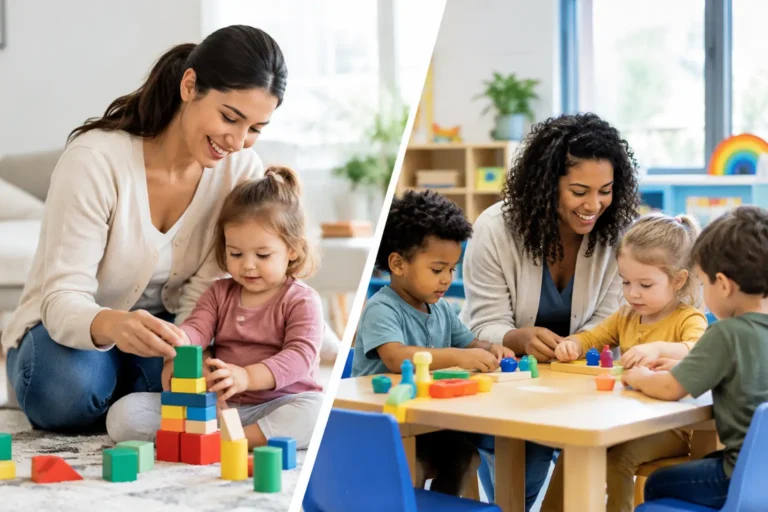
When the partnership is thoughtful, speech and language goals do not have to interrupt childhood. A toddler practicing requests may be encouraged to use a word, sign, gesture, or picture before receiving more bubbles. A preschooler working on turn-taking may get extra support during block play. A child building vocabulary may hear rich, simple language during handwashing, snack, outdoor play, and story time.
This approach honors a powerful truth: children learn communication through relationships. They need time to try, caring adults who wait for their response, and peers who make conversation meaningful.
A short therapy session can be valuable, but children spend much more time in everyday routines. That is where an inclusive early learning environment can make a meaningful difference. Repetition is built into a young child’s day without making learning feel repetitive or pressured.
At arrival, a caregiver might greet a child by name and pause for a wave, sound, sign, or response. During snack, children can practice choosing between two foods, asking for more, and talking with friends. During dramatic play, they try new words as they become cooks, veterinarians, builders, or superheroes. At pickup, teachers can share a small communication win with a family: “She told her friend, ‘My turn,’ during the train game.”
These moments build confidence as well as language. A child who experiences success communicating is more likely to try again. That is why a growth-mindset environment matters. Rather than focusing on what a child cannot yet say, caring educators notice effort: the new sound, the longer phrase, the brave attempt to join a conversation, or the choice to use a gesture instead of becoming frustrated.
Progress is rarely a straight line. A child may use a new word often at home and not at school, or speak freely with one trusted teacher but become quiet in a group. This does not mean the effort is failing. It means adults should stay curious, patient, and responsive.
Speech and language development includes much more than pronunciation. Some children need help understanding directions, using words to express needs, joining conversations, telling stories, or producing certain sounds. Others communicate effectively with few spoken words through gestures, signs, pictures, devices, facial expressions, or a combination of methods.
The best support meets a child where they are. For a child who is still learning to use words, adults may offer choices and model short phrases without demanding repetition. For a child who becomes frustrated when misunderstood, visual supports and calm wait time may help. For a child who is learning more than one language, educators should respect and welcome the home language rather than treating bilingual development as a problem.
There are trade-offs to consider. Pulling a child from the classroom for a therapy session may allow focused work with a specialist, while classroom-based support can help skills carry over to real social situations. Neither option is automatically better. The right fit depends on the child’s needs, the therapist’s recommendations, the family’s schedule, and the program’s ability to collaborate respectfully.
Before choosing a program that promotes speech support or therapist partnerships, ask direct questions. Clear communication is a sign of a center that values families as partners.
Ask whether outside therapists are welcome to visit, what consent is required, and where sessions take place. Find out how teachers receive recommendations and how they incorporate them without labeling or isolating a child. It is also helpful to ask how the center protects privacy, communicates developmental observations, and handles classroom transitions when a child is receiving support.
You may also want to know how the program responds to concerns before a formal evaluation occurs. A supportive answer sounds balanced. Educators should be able to share specific observations, such as “He is using gestures consistently but rarely combining words,” while avoiding alarming labels or comparisons to other children. They should listen to what you see at home and encourage you to consult your child’s pediatrician or a qualified speech-language pathologist when appropriate.
Most of all, notice the language a center uses about children. Does the staff speak with warmth and specificity? Do they describe strengths alongside challenges? Are they willing to adapt activities so every child can participate? A judgment-free setting does not ignore developmental needs. It addresses them with care, skill, and respect.
Children should never feel that every interaction is a test. The goal is connection, not perfect performance. Teachers can create supportive communication moments by getting down to a child’s level, following their interests, and giving them enough time to respond.
Instead of asking a rapid series of questions, an educator might narrate what is happening: “You found the big red truck. It is going fast.” This gives a child useful language without putting them on the spot. If the child says “truck go,” the teacher can gently expand the idea: “Yes, the truck is going fast.”
Small groups are especially helpful because children have more chances to be heard. In a busy classroom, a child with emerging language can easily let others speak for them. In a smaller, responsive group, teachers can pause, invite participation, and celebrate attempts while still keeping play joyful.
Consistency between home and school also helps. Families do not need to turn every evening into a therapy session. Sharing a few strategies can be enough: wait before offering help, give simple choices, read a favorite book again, or model a word during a routine your child already enjoys. When children hear similar supportive language from the people they trust, they receive a clear message: your ideas matter, and we are here to understand you.
Every child develops at their own pace, and no single milestone tells the whole story. Still, it can be helpful to seek professional guidance if your child often seems frustrated trying to communicate, has difficulty understanding everyday language, loses skills they previously used, is hard for familiar adults to understand, or is not making the communication progress you would expect over time.
Trust your observations. You know your child’s personality, routines, and ways of connecting better than anyone. Starting a conversation with a pediatrician or speech-language pathologist is not a prediction about your child’s future. It is a way to gather information and identify supports that may make daily life easier.
At Growth Mindset Learning Lab, we believe children grow when effort is noticed, differences are respected, and families are met without judgment. Whether your child is sharing their first word, practicing a tricky sound, or learning how to tell a friend what they need, each step deserves encouragement. A caring classroom can give that encouragement a place to grow every day.