Physical Address
381 Myrtle Avenue, Brooklyn, NY 11205
Physical Address
381 Myrtle Avenue, Brooklyn, NY 11205
See how growth mindset helps preschoolers build confidence, resilience, curiosity, and early learning skills through playful daily practice at home now.
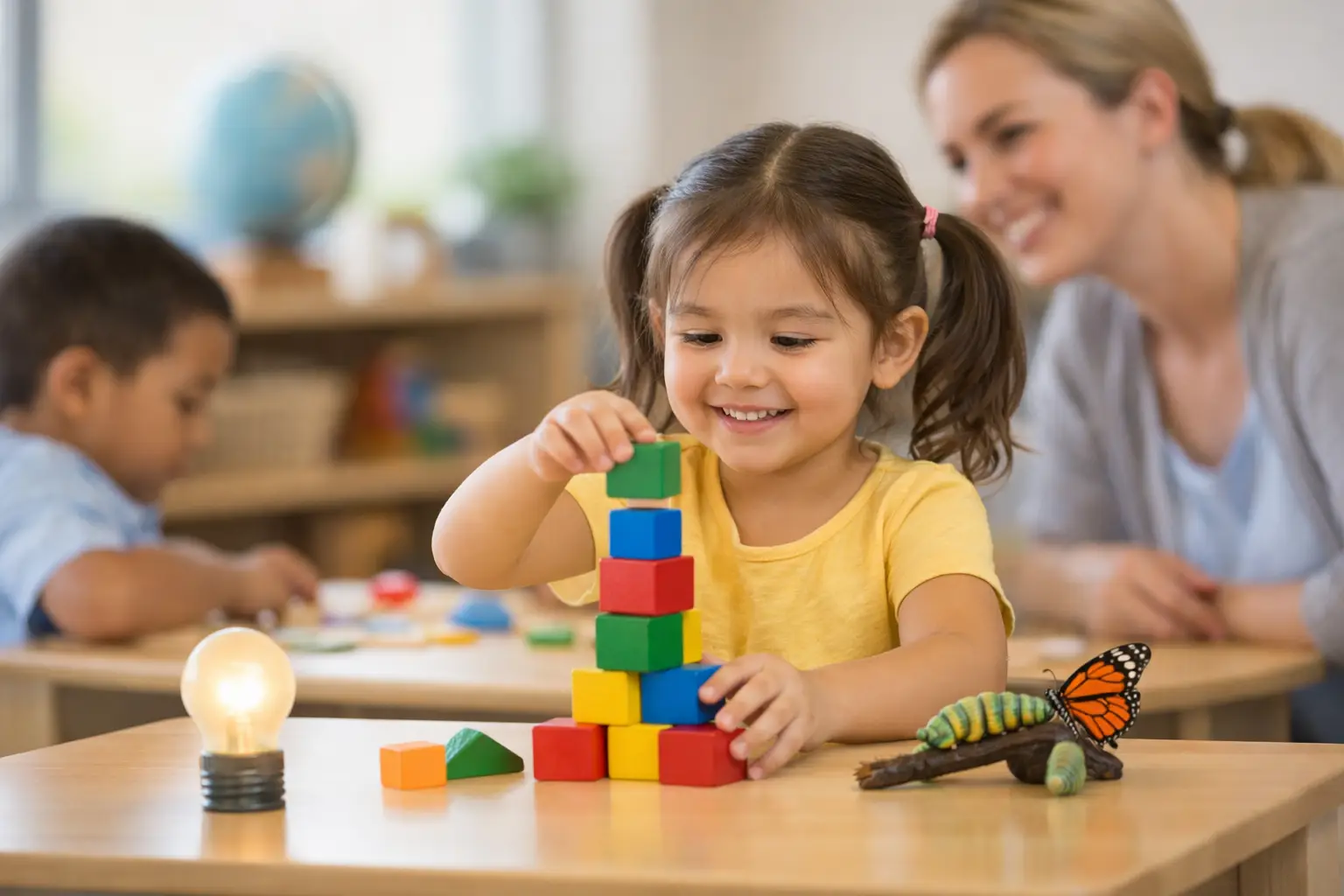
A preschooler stands over a block tower that has fallen for the third time. They may scrunch their face, push the blocks away, and say, “I can’t do it.” That small moment is not a failure. It is a chance to help a child learn that hard things can be worked through with time, support, and another try.
How growth mindset helps preschoolers is less about teaching a big educational concept and more about shaping the messages children receive every day. When adults notice effort, welcome questions, and make room for mistakes, children begin to see themselves as capable learners. They learn that skills are not something a person either has or does not have. Skills grow through practice, play, and persistence.
A growth mindset is the belief that people can improve their abilities through effort, helpful strategies, practice, and support. For preschoolers, this idea must feel concrete. Young children are not expected to explain brain science or independently push through every challenge. They are learning through the caring responses of the adults around them.
In a preschool classroom or at home, growth mindset language sounds simple: “You kept trying different pieces until the puzzle fit.” “That was frustrating. Let’s take a breath and try a new way.” “You cannot zip your coat by yourself yet, but your hands are getting stronger with practice.”
The word yet matters because it leaves the door open. It honors what a child can do today without placing a limit on what they may be ready to do tomorrow. This is especially meaningful in the preschool years, when children develop at wonderfully different rates.
Confidence is not built by telling children they are amazing at everything. It grows when children experience themselves handling a challenge with support. A child who pours water, spills some, wipes it up, and tries again gains more than a dry table. They learn, “I can respond when something goes wrong.”
Praise plays a role here, but the kind of praise matters. General statements such as “You’re so smart” may feel good in the moment, yet they can accidentally make children worry about proving they are smart. Process-focused encouragement gives them something they can use again. Instead of focusing only on the finished painting, notice the choices involved: “You mixed blue and yellow to make that green,” or “You stayed with your picture even when the marker ran out.”
This does not mean children should never hear “Good job.” Warm celebration belongs in childhood. The goal is simply to add more specific observations that help children connect their actions to their progress.
Preschoolers are naturally experimental. They test what happens when they stack, pour, sort, climb, pretend, ask, and try. A growth-minded environment protects that curiosity. Rather than rushing to correct every mistake, adults can pause and invite thinking.
If a child puts a triangle in the wrong puzzle space, an educator might say, “That piece did not fit there. What do you notice about its sides?” If paint colors turn brown instead of the expected purple, the response can be, “You discovered what happens when those colors mix. What would you like to try next?”
There are times when an adult needs to step in quickly, especially for safety, kindness, or a child who is becoming overwhelmed. Growth mindset does not mean leaving a child alone with frustration. It means treating setbacks as information, then offering the right amount of support.
Resilience in preschool does not look like a child never crying, getting angry, or asking for help. It looks like a child gradually learning what to do with those feelings. They may pause, use words, accept comfort, choose a new strategy, or return to an activity after a break.
Play offers a gentle place to practice these skills. Waiting for a turn in a game, rebuilding a train track, learning to use scissors, or joining a group activity all bring manageable challenges. With a patient adult nearby, children can practice persistence without feeling judged for needing help.
The challenge must match the child. If an activity is far too difficult, repeated frustration can discourage participation. If it is always too easy, children miss the satisfaction of stretching their abilities. Personalized support helps find that middle ground, where children can say, “This is hard,” and also discover, “I can keep going.”
Preschool learning happens with other people. Children are figuring out how to share materials, enter play, express a need, recover from disappointment, and notice another person’s feelings. A growth mindset supports these developing social skills because it frames them as learnable.
Instead of labeling a child as “shy,” “bossy,” or “bad at sharing,” adults can describe the moment and guide a next step. “You wanted the truck, and Maya was using it. You are learning how to ask for a turn.” “You had a big feeling when the game changed. Let’s find words to tell your friends.”
This approach does not excuse hurtful behavior. Boundaries still matter. Children need clear, calm guidance that keeps everyone safe. But when we separate the child from the behavior, we make room for growth. A preschooler is not defined by one hard moment. They are learning skills they will practice many times.
Growth mindset does not require worksheets, rewards, or perfectly phrased conversations. It can live in ordinary routines. When your child struggles to put on shoes, resist the urge to take over immediately. Offer one small cue, wait, and notice their effort. When they say they cannot draw a person, invite them to make one circle or add two legs first.
You can also model your own learning. Say, “I made a mistake on this recipe, so I am going to read the directions again,” or “I am still learning how to fix this. I’ll try a different tool.” Children learn from watching adults respond to challenges with calm honesty.
Try to make room for a child’s ideas, even when their approach is slower or messier than yours. A child who is allowed to scoop, sort, build, and problem-solve develops agency. Of course, busy mornings and safety concerns sometimes call for adults to move things along. The goal is not to turn every task into a lesson. It is to notice a few moments each day when your child can practice doing, trying, and thinking for themselves.
A growth mindset thrives when children feel emotionally safe. They need to know that adults will notice their efforts, celebrate milestones, and stay close when learning feels difficult. In a nurturing preschool setting, educators observe each child’s interests, strengths, communication style, and developmental needs. That information helps them offer invitations that are meaningful rather than one-size-fits-all.
For one child, persistence may mean returning to a sensory activity after feeling unsure. For another, it may mean trying a new letter sound or speaking up during circle time. Progress does not always look dramatic. Sometimes it is a child asking for help instead of giving up, trying one bite of a new food, or using words after a conflict.
At Growth Mindset Learning Lab, learn-through-play experiences make space for those individual wins. Children are encouraged to explore, apply effort, and build confidence in a judgment-free community. Families benefit, too, when educators share the small steps they see, creating a consistent bridge between school and home.
A preschooler does not need to be fearless to become a confident learner. They simply need caring adults who can say, again and again, “This is tricky, and you are not alone. Let’s see what you can try next.”