Physical Address
381 Myrtle Avenue, Brooklyn, NY 11205
Physical Address
381 Myrtle Avenue, Brooklyn, NY 11205

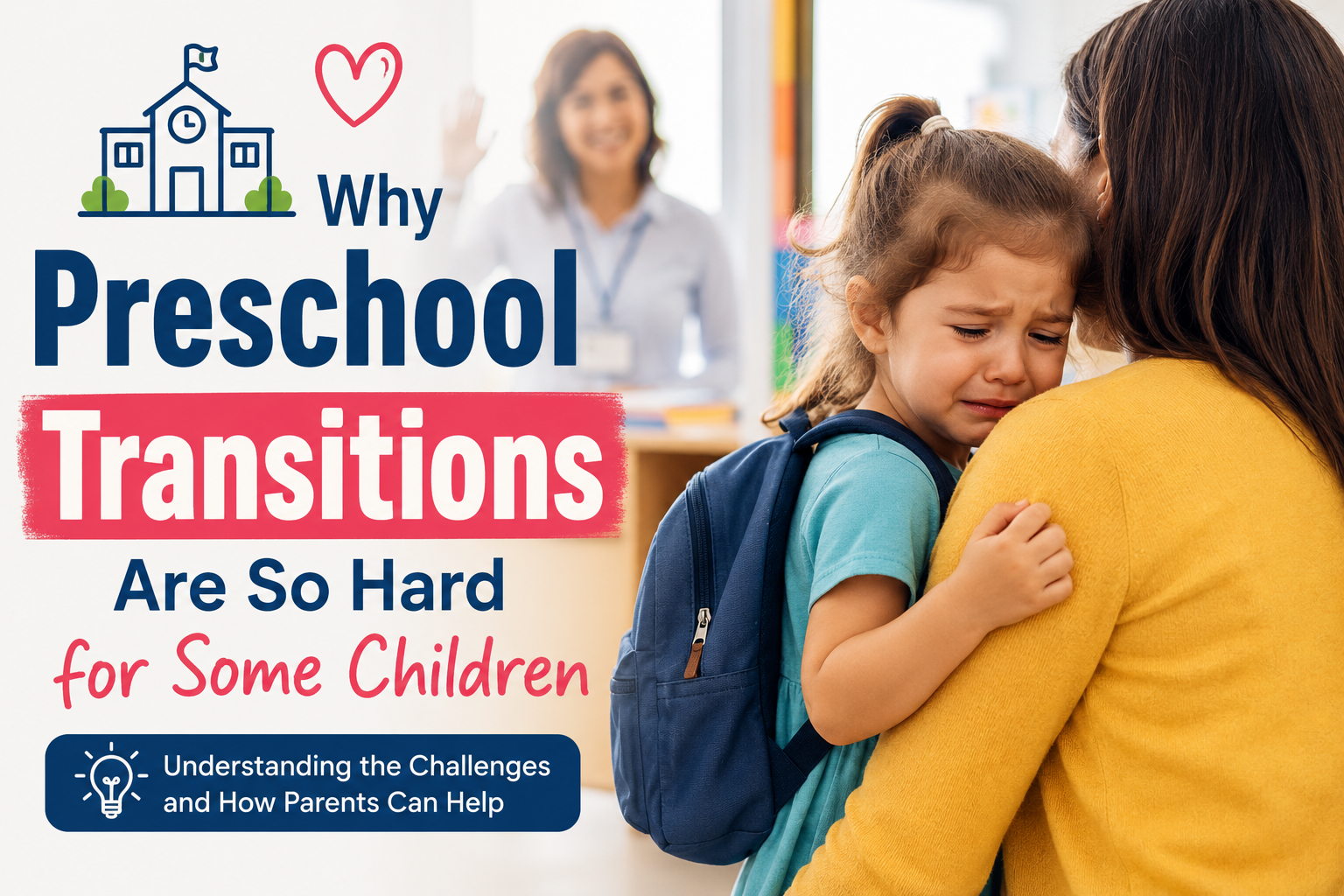
Starting preschool is a big milestone, but not every child walks through the classroom door feeling excited and ready.
One child may wave goodbye, find a toy and settle into the morning quickly. Another may cling tightly to a parent, cry at drop-off, refuse to get dressed for preschool, or repeatedly ask to stay home.
Both children are responding to a major change.
Preschool transitions can be difficult because young children are adjusting to several things at once: separating from familiar caregivers, entering a new environment, following new routines, building relationships with teachers, and spending time with other children.
Some children adapt quickly. Others need more time, consistency, and reassurance.
If your child is still getting ready to start, learning how to prepare your child for their first day of preschool can make some parts of the experience more predictable before the first morning arrives.
This guide explains why preschool transitions can feel so hard, the signs that a child may be struggling, what parents can do to make the adjustment easier, and what to avoid during the preschool adjustment period.
Preschool transitions can be difficult because children are dealing with separation, unfamiliar people, new routines, classroom expectations, and a different daily environment.
Temperament also matters. Some children are naturally comfortable with change, while others need more time to observe and feel familiar with a new situation.
Crying, clinginess, or resistance at the beginning does not automatically mean your child is not ready for preschool.
Instead of focusing on one difficult drop-off, look at the overall pattern. Is your child gradually becoming more familiar with the teacher? Are the tears becoming shorter? Are they beginning to talk about activities, classmates, or things they enjoyed?
Small changes can be important signs of adjustment.
A preschool transition is the period when a child adjusts to starting preschool, returning after a long break, or moving into a new classroom.
It involves much more than walking into a new building.
Your child may be learning to:
That is a lot of change for a young child to manage at once.
Adjustment is not a competition. One child settling quickly does not mean another child who needs more time is failing.
There is rarely one single reason.
Several factors can make the transition more challenging for one child than another.
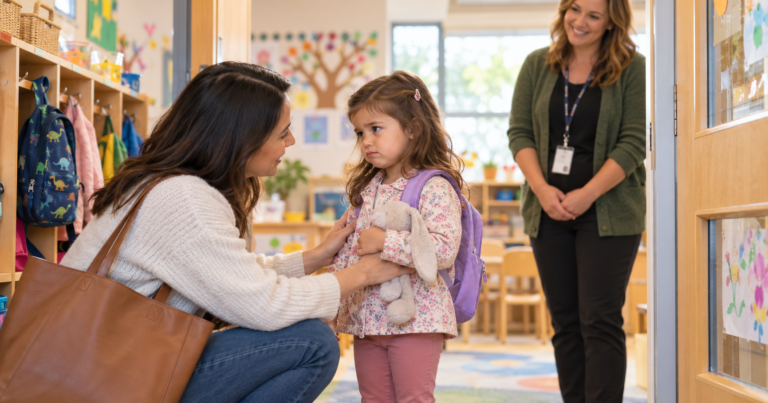
For some children, the hardest part of preschool is saying goodbye.
Young children depend heavily on familiar caregivers for comfort and reassurance. Entering a classroom and watching a parent leave can therefore bring strong emotions, even when the child enjoys preschool once the day begins.
Some children cry before their parent leaves but settle shortly afterward. Others may need longer to build confidence with the separation.
If morning separation is becoming the main difficulty, understanding preschool drop-off anxiety can help you respond more consistently.
Imagine arriving somewhere where you do not know the people, routines, rules, or even where the bathroom is.
That is often what starting preschool feels like to a child.
They may be wondering:
Who will help me if I need something?
When will my parent come back?
Where do I put my things?
What happens after snack?
Who can I play with?
As the environment becomes more familiar, some of this uncertainty may reduce.
Young children often do better when they know what happens next.
Preschool may introduce a completely different rhythm involving arrival, circle time, activities, snacks, outdoor play, clean-up, lunch, rest, and pickup.
Even positive changes can feel difficult when they replace a familiar routine at home.
Consistent routines can make daily life more predictable for young children, which is why repeating similar morning and drop-off steps can be helpful during adjustment.
Children have different temperaments.
Some immediately explore a new room and approach unfamiliar children.
Others prefer to observe first.
A child who stays close to the teacher or watches other children playing before joining in is not necessarily struggling socially. They may simply need more time to feel comfortable.
Try not to compare your child’s adjustment with another child’s.
Preschool classrooms can include conversations, music, toys, movement, group activities, and several children playing at once.
For some children, that level of activity is exciting.
For others, it can initially feel overwhelming.
A child may enjoy individual activities but still need time to become comfortable with the noise, movement and social demands of the wider classroom.
At home, parents often understand what a child wants from a look, gesture or unfinished sentence.
A new teacher does not yet know the child as well.
Children who are still developing their communication skills may initially find it harder to ask for help, explain that they need the bathroom, join a game, or tell someone that they are upset.
Building trust with teachers can make these situations easier over time.
Starting preschool is one big transition, but the school day contains many smaller ones.
Children may need to stop playing, clean up, sit for a group activity, move outside, return indoors, eat lunch and prepare for pickup.
Some children find switching activities particularly challenging.
Teachers and parents can make these moments easier by using warnings, predictable routines and simple cues. You may also find these transition ideas for preschoolers useful when helping a child understand what comes next.
Children do not always say, “I’m finding this change difficult.”
Instead, parents may notice changes in behaviour.
Possible signs include:
Your child may suddenly want to stay very close to you, ask to be carried more often, or become upset when you leave the room.
You may notice your child refusing to get dressed, asking to stay home, or becoming upset as soon as preschool is mentioned.
Crying during separation is common during adjustment, particularly when preschool is still unfamiliar.
What matters is the broader pattern, including whether the distress gradually reduces and how your child behaves after you leave.
Some children are much more tired, irritable or easily frustrated after a preschool day.
They may cry over small problems, become argumentative or have tantrums shortly after getting home.
If evenings are particularly difficult, our guide to after-daycare meltdowns explains how tiredness, hunger, stimulation and the transition home can contribute.
Major routine changes can sometimes coincide with difficulty settling at bedtime, waking during the night or needing more reassurance.
Parents sometimes notice a child wanting more help with things they previously did independently.
Rather than immediately treating this as misbehaviour, consider whether your child is also adapting to a significant change.
Some children show stress through crying or tantrums. Others become quieter.
Pay attention if your child becomes noticeably withdrawn or loses interest in activities they normally enjoy, particularly if the change is persistent.
You cannot remove every difficult feeling from starting preschool, but you can make the experience more predictable.
Try to keep the basic order of the morning similar on preschool days.
For example:
Wake up → breakfast → get dressed → brush teeth → shoes and bag → leave for preschool
The routine does not need to run perfectly every day. The goal is simply to help your child know what comes next.
Avoid promising that your child will “love every minute” or that they will not feel sad.
Instead, explain preschool simply and realistically.
You might say:
“You’ll go into your classroom and I’ll say goodbye. Your teacher will be there with you. You’ll play, have your activities, and I’ll come back after preschool.”
Predictability can be more reassuring than trying to convince a worried child that everything will be fun.
When it is time to leave, say goodbye rather than disappearing without telling your child.
Use a simple routine you can repeat each morning.
For example:
One hug.
One kiss.
“Have a good day. I’ll see you after preschool.”
Then allow the teacher to take over.
A consistent goodbye gives your child a pattern they can gradually learn.
If your child says they do not want you to leave, you do not need to argue with the feeling.
Instead of:
“There’s nothing to cry about.”
Try:
“I know saying goodbye feels hard.”
Then calmly remind them what will happen:
“Your teacher will stay with you, and I’ll come back after preschool.”
Acknowledging a feeling does not mean changing the boundary.
Simple skills can help children feel more confident in a classroom.
Practise things such as:
The goal is not perfection.
It is helping your child feel capable of handling some parts of their preschool day.
Young children often process new situations through stories and play.
Read books about starting preschool or use toys to act out a school morning.
For example, one toy can be the parent, another can be the teacher and another can be the child.
Practise arriving, saying goodbye, playing and then being picked up again.
This allows your child to explore the sequence in a low-pressure environment.
When preschool itself is new, familiar routines at home can provide some stability.
Try to keep meals, bedtime and other important routines reasonably consistent.
Children do not need a rigid schedule, but knowing roughly what happens next can make busy days easier to manage.
Avoid expecting your child to immediately answer many questions when you pick them up.
Some children need a little time to reconnect and settle.
Instead of asking:
“What did you do?”
“Who did you play with?”
“Did you cry?”
“Did you eat?”
Start simply:
“I’m happy to see you.”
Conversation about the day can happen later.
If your child is struggling with the wider adjustment to childcare, you may also find our guide on how to help a toddler adjust to daycare useful.
Parents often want to help so much that they accidentally make the transition more complicated.
Here are some things worth avoiding.
Leaving without saying goodbye may avoid tears in that moment, but your child may then become unsure about when you might disappear.
A clear goodbye is usually more predictable.
If you have decided to leave, repeatedly returning for another hug, another explanation, or another goodbye can make the separation longer.
Keep your goodbye loving, simple, and consistent.
Avoid comments such as:
“Look, everyone else is going inside.”
“Your cousin never cries.”
“Why can’t you be brave like your friend?”
Children adjust differently.
Comparison adds pressure without solving what your child is finding difficult.
Your child may miss you.
They may dislike an activity.
They may have a difficult morning.
Instead of promising that everything will be perfect, communicate that adults will help them when things feel difficult.
If your child is already tired, asking a long series of questions about whether they cried, what they ate, and exactly what happened may feel overwhelming.
Reconnect first.
Talk later.
Crying at drop-off does not, by itself, tell you how the rest of your child’s day is going.
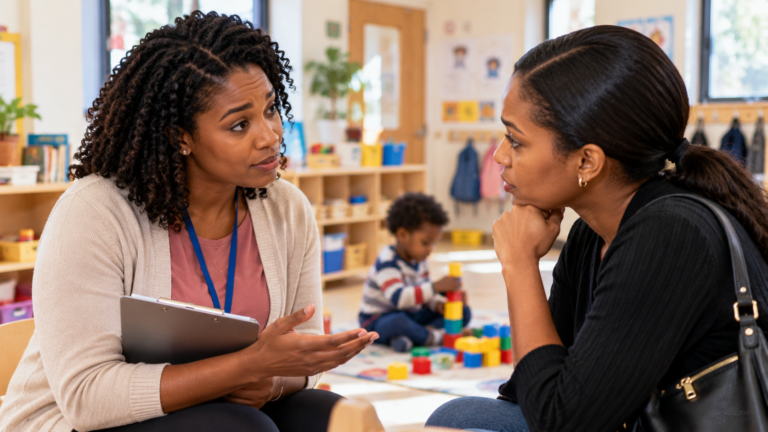
Talk to the teacher.
Ask how long your child remains upset, whether they participate later, and what helps them settle.
This can be particularly confusing.
A teacher may tell you that your child played, listened, and participated well, while you see crying, defiance, or clinginess after pickup.
Both observations can be true.
By the end of preschool, your child may be tired, hungry, or adjusting from a structured classroom back into home life.
Different environments also bring different expectations and relationships.
If this pattern is happening regularly, understanding why some children behave better at preschool than at home can help you look at the situation more closely without assuming your child is deliberately behaving badly for you.
Progress does not always mean suddenly walking into preschool without a single tear.
Look for smaller changes.
Your child may:
Adjustment can be gradual.
Small improvements still count.
You do not need to wait until there is a serious problem.
If your child is having a difficult transition, ask the teacher what they are observing.
Useful questions include:
“How long does my child remain upset after I leave?”
“What helps them settle?”
“Are they joining activities?”
“Are they eating and using the bathroom normally?”
“How are they interacting with other children?”
“Is there a particular part of the day they find difficult?”
“Have you noticed improvement since they started?”
Comparing what you see at home with what the teacher sees in the classroom gives you a much clearer picture.
Many children need time to adjust to preschool, but persistent or severe distress deserves closer attention.
Consider speaking with your child’s teacher and healthcare professional if:
There is no single adjustment timeline that applies to every child.
The frequency, intensity, and direction of the behaviour are often more useful than counting the exact number of days or weeks.
There is no exact timetable. Some children settle relatively quickly, while others need more time to become familiar with the classroom, teacher and separation routine. Look for gradual progress rather than expecting your child to adjust by a particular date.
Drop-off tears can happen when a child is adapting to separation and a new environment. What matters is what happens afterward. Ask the teacher how quickly your child settles and whether the overall pattern is improving.
The idea of preschool and the daily reality can feel different. Once your child realises that preschool includes regular separation, routines and expectations, some resistance may appear. Ask what specifically feels difficult rather than assuming they dislike everything about preschool.
Talk simply about what will happen, practise the morning routine, visit the setting when possible, read preschool stories and help your child practise small independence skills such as carrying their bag or asking an adult for help.
A long goodbye can sometimes extend the separation. A short, warm, and predictable goodbye is often easier for children to understand. Work with the teacher on a handover routine that can be repeated consistently.
Avoid sneaking away, repeatedly extending goodbyes, comparing your child with other children, making unrealistic promises about preschool, and treating every difficult drop-off as evidence that something is wrong.
A major change in routine can sometimes coincide with temporary changes in sleep. Keep bedtime predictable and pay attention to whether the sleep change improves as preschool becomes more familiar.
Not necessarily. Starting preschool requires children to learn new routines, relationships and separation skills. A difficult beginning can be part of the adjustment process rather than proof that a child is not ready.
Tiredness, hunger, transitions and differences between the preschool and home environments can all affect behaviour after pickup.
Pay closer attention when distress is unusually intense, persistent, getting worse or accompanied by significant changes in sleeping, eating, behaviour or your child’s general wellbeing. Speak with the teacher and healthcare professional when you are concerned.
Preschool is a major change in a young child’s world.
A child who cries at the classroom door is not necessarily failing to adjust, just as a child who walks straight inside is not automatically more ready.
Children bring different temperaments, experiences, communication skills and comfort levels with change.
Your role is not to prevent every uncomfortable feeling.
It is to make the transition predictable, offer reassurance, maintain reasonable routines and work with your child’s teacher to understand what they need.
Watch for progress rather than perfection.
A shorter goodbye, a new friend’s name, an excited story about an activity or a child who begins walking into the classroom with slightly more confidence can all be signs that preschool is becoming more familiar.
Centers for Disease Control and Prevention: Tips for Building Structure
Centers for Disease Control and Prevention: Tips for Creating Structure and Rules
American Academy of Pediatrics, HealthyChildren.org: How to Ease Your Child’s Separation Anxiety
Centers for Disease Control and Prevention: Positive Parenting Tips for Toddlers