Physical Address
381 Myrtle Avenue, Brooklyn, NY 11205
Physical Address
381 Myrtle Avenue, Brooklyn, NY 11205

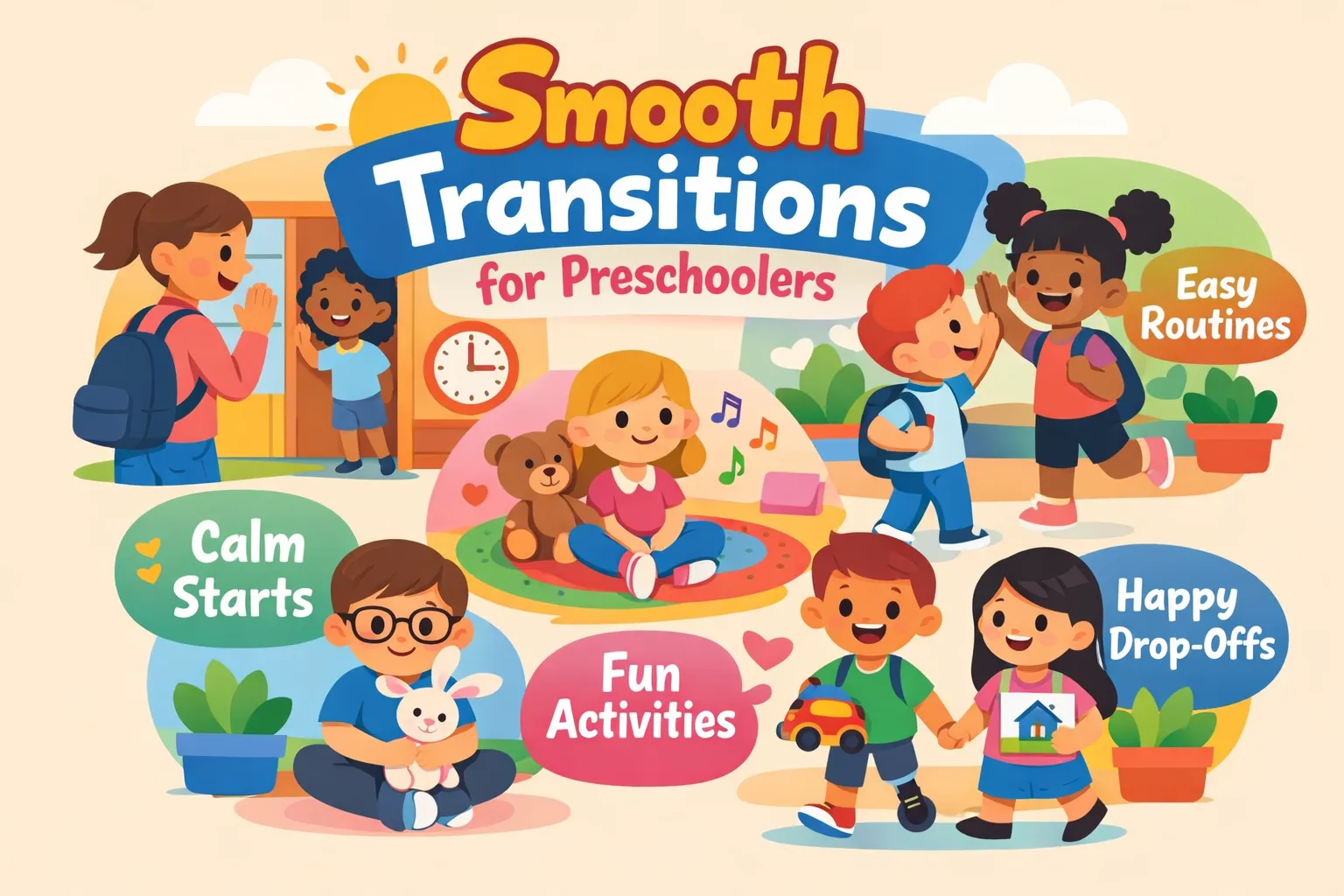
Transition ideas for preschoolers can turn a chaotic handoff into a calm, predictable moment that lowers tears and sets clear expectations for the day. A short, consistent ritual helps children regulate and learn what comes next, which frees up more classroom time and shortens repeated goodbyes. Below are ten practical preschool transition activities, each with a one-line script, exact props, and suggested timing so you can start the same day.
The first handoff often shapes how the morning unfolds. A calm, consistent ritual helps children regulate, reduces tears, and clarifies what happens next so the day starts with less friction. Among transition ideas for preschoolers, the drop-off routine is easiest to standardize because it needs only predictability and a brief, loving closure.
Use two practical tools together: a tactile transition object that stays with the child and a tech-enabled nudge that reminds families of the routine. The tactile item gives a physical cue while a short goodbye anchors the emotion, and the handoff should take about 30–60 seconds. The Mindset Moment app can send a reminder 10–15 minutes before drop-off with a one-line script and a quick checklist families can read in 10–20 seconds.
Choose simple props like a small stuffed animal, a laminated sun token that fits a pocket, or a caregiver photo for anxious children. Use the same one-line goodbye every day, for example: “Two hugs, one smile. I will pick you up at 3.” For children who are nonverbal or sensory-sensitive, swap the token for a picture exchange, a tactile fabric square, or a touch-to-hand signal and consider adding a short transition song if that fits your classroom style.
When energy is high, calming transitions restore focus and prepare children for quieter group times. Use predictable, sensory-friendly cues after outdoor play, before circle time, or during a tearful drop-off to help bodies settle. The following ideas are short, easy to prepare, and adaptable for diverse sensory needs. For research-based guidance on predictable routines and why they help young children, see the CSEFEL brief on transitions.
Discovery bottles or sensory jars: Give each child a sealed discovery bottle to gently shake and inspect while they settle on the carpet, then ask a single question such as “Can you find the blue shell?” Estimated time: 2–3 minutes. Props: small plastic bottles, water, glitter, beads or themed objects, and strong glue for sealing so jars are reusable. For children sensitive to sound or motion, offer visual-only bottles and tabletop exploration, or provide tactile trays for a hands-on calming option.
Short breathing chant and story snaps: Lead a 30–60 second “bunny breaths” chant, then use a one-minute two-line story snap to shift attention: “Breathe in like a flower, blow out the candle.” Estimated time: 1–2 minutes. Props: picture cards of a flower and a candle or a printed script for substitutes, plus a soft squeeze ball for children who need stronger sensory input.
When the group needs a quick energy release, short movement bursts reset attention and reduce wiggles without derailing the schedule. Use 30–90 second activities before outdoor time or after long quiet periods to channel energy into a focused task. Keep cues consistent so children learn when to move and when to settle.
Simon Says with animal walks: Play one minute of Simon Says using animal actions as the movement cue, for example, “Simon says hop like a frog to the rug.” Estimated time: 1–2 minutes. Adaptations: use seated arm or facial versions for children with mobility limits, and add clear visual gesture cards for children who respond better to pictures than spoken directions.
Freeze dance or short movement clip: Play 30–45 seconds of an upbeat song and instruct children to dance, then freeze on a consistent cue such as “statue.” Estimated time: about 1 minute. Use a visual “freeze” card and a light tap for children with hearing differences, and offer chair-dance moves as a seated alternative. For more quick movement and transition activity ideas to rotate through your week, check out myBrightWheel’s transition activities. Also consider pairing short songs or circle-time tunes with these bursts; a helpful collection of preschool circle-time song ideas can be found in the RevTrak preschool circle time songs guide.
Keep these games in your daily toolkit: they require almost no setup and can be adapted across abilities. Rotate cue words or animal choices weekly to maintain interest and teach flexibility. The next section covers lining-up routines that make transitions through halls and doors faster and quieter.
Short, predictable cues cut noise and boost safety. A two-step signal, an attention cue followed by a movement prompt, helps children learn expectations and settle into orderly lines. Replace long instructions with consistent sensory markers so adults can supervise more easily while children follow the routine.
Color hunt plus lining-up song: On the way to line up, call out a color and have children point to or touch an object of that color, then sing a 15–20 second lining-up song such as “I am ready, I will wait” to set behavior expectations. Estimated time: 1–2 minutes. Props: laminated color cards and a short lyric card; use photos of classroom items for English learners and allow children who cannot move quickly to point from their spot.
Train whistle and follow-the-leader: Use a soft train whistle or a recorded “choo” sound as the cue to form a train, then let a child or teacher lead with quiet voices while others follow in line. Estimated time: about 1 minute. Props: toy whistle or phone sound file and optional “train seat” flags for wall hooks; place spaced “car” marks on the floor for children who prefer more personal space.
Make props child-facing and low-prep: print and laminate color cards, post seat flags at child height, and practice both cues twice a day so the routine becomes automatic. Store printable props in a binder near the door for quick access. These lining-up activities pair well with the printable transition props shared later; for classroom-level strategies on calming transitions and routines, read Tranquil Transitions. You can also find additional practical examples in the Daycare Transitions Archives, Mindset Moment.
Short, playful cleanup rituals can cut center-switch time and teach children to manage their own spaces. When transitions feel predictable, the room runs more smoothly and teachers gain minutes for instruction. Below are a cleanup game and a visual schedule system you can share with families through the Mindset Moment app.
Elephant cleanup and timer race: Turn tidying into a game by inviting children to “use your trunk to pick up the blocks” while a two-minute timer counts down, then ring a soft bell to celebrate a clear floor. Estimated time: 2–3 minutes. Props: a soft play bell, a kitchen or sand timer, and printable single-picture job cards; pair children with buddies or assign one job per child for clarity, and extend the timer for those who need a slower pace.
Keep a small visual schedule with magnetic or velcro cards near the door and attach matching printable cards to a parent reminder sent from the Mindset Moment app so home and class use the same cues. Referencing the visual takes 30–60 seconds per transition and helps children learn the sequence: wash hands, line up, backpacks on. Use real photos for children learning English, simplified icons for children who process less detail, and add a one- or two-word strip for early readers. For more strategies related to behavior changes after preschool and ways to support families during those adjustments, see the after preschool behavior changes Archives, Mindset Moment.
You can make drop-off and daily routines smoother by using simple, consistent transition ideas for preschoolers that match your child’s energy. A brief, predictable handoff sets the tone for the morning and helps children regulate before class starts. Matching calming transitions after high-energy play and short energizing bursts before outdoor time reduces last-minute meltdowns and protects learning time.
Take one concrete step tonight: write a two-step drop-off ritual and practice it tomorrow morning. Try a 90-second routine: greet, one hug or high-five, and a quick “see you later” phrase followed by a consistent handover, and note how your child responds. Download the printable checklist from Mindset Moment to choose one calming and one energizing transition to test for a week, then record what improves so you can keep the routines that work. For additional practical activity lists and printable routine cards you can adapt immediately, review 7 fun and engaging transition activities for preschoolers and the preschool drop off crying Archives, Mindset Moment.