Physical Address
381 Myrtle Avenue, Brooklyn, NY 11205
Physical Address
381 Myrtle Avenue, Brooklyn, NY 11205

Our infant care developmental milestones guide helps parents notice growth, encourage play, and know when to seek supportive professional guidance early.
A baby’s first year can feel like a rapid series of beautiful changes: a first steady gaze, a hand reaching for yours, a new babble during breakfast. An infant care developmental milestones guide can help you recognize these moments without turning your child’s growth into a race. Milestones offer useful signposts, but they are not a report card. Every baby brings a personal temperament, pace, and set of strengths to the learning process.
At Growth Mindset Learning Lab, we believe even the earliest learning is built through warm relationships, repetition, play, and encouragement. When adults notice a baby’s efforts and respond with care, babies gain more than a new skill. They build security, curiosity, and confidence to keep trying.
Developmental milestones describe skills that many children begin to show within a general age range. They usually fall into four connected areas: social and emotional development, communication, movement, and thinking or problem-solving. A baby may move ahead in one area while taking more time in another. For example, a child who is focused on learning to crawl may be quieter for a few weeks, while a highly social baby may spend longer observing before attempting new physical skills.
The goal is to watch patterns over time, not to compare your infant with a friend’s baby, a sibling, or a chart on social media. Consistent progress, engagement with people and surroundings, and growing opportunities to practice are meaningful signs of development. If your baby was born more than three weeks early, ask their pediatrician whether using their adjusted age is appropriate when reviewing milestones.
In the first months, babies are learning that their needs will be noticed and met. They may briefly lift their head during tummy time, move both arms and legs, bring hands toward their mouth, or turn toward familiar voices. Many begin making cooing sounds and show interest in faces, especially the faces of trusted caregivers.
Simple, responsive routines do powerful developmental work at this age. Talk through diaper changes, pause when your baby makes a sound, and answer with your own gentle voice. Offer short, supervised tummy-time sessions while your baby is awake, gradually building time as they tolerate it. If your baby becomes upset, comfort is not a setback. Feeling safe is part of the learning.
Many babies become more active and expressive during this period. You may see rolling, pushing up on arms during tummy time, reaching toward toys, or bringing objects to the mouth to explore. Laughter, squeals, and back-and-forth sounds often become part of daily life. Some babies begin recognizing familiar people and showing clear excitement when a loved one enters the room.
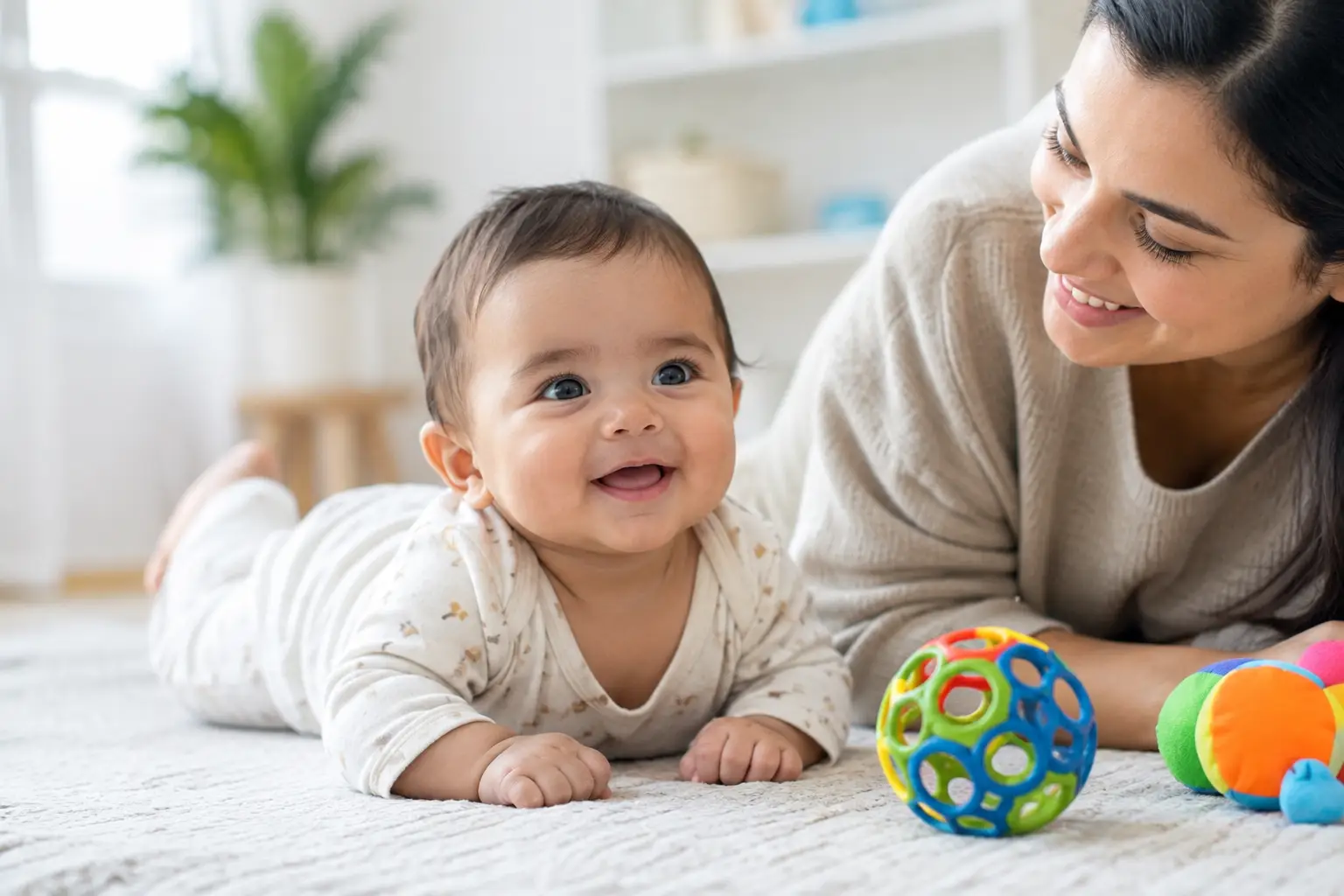
Place a colorful, age-appropriate toy just within reach during floor play. Sing familiar songs and pause for your baby’s sounds as though you are taking turns in a conversation. These small exchanges support coordination, language, and the joyful understanding that communication matters.
Babies often become determined explorers around this age. They may sit without support, transfer objects from one hand to another, bang toys together, or begin scooting and crawling. They may respond to their name, recognize common words, and use gestures or sounds to get your attention.
This is also when separation anxiety can become more noticeable. A baby who cries at drop-off or reaches for a parent is not being difficult. They are showing a growing awareness of who feels familiar and safe. Consistent goodbyes, calm caregiver handoffs, and predictable routines can make transitions gentler over time.
Create a safe space for active floor exploration rather than placing your baby in equipment for long periods. Put a few safe objects nearby, then let them choose what to inspect. A wooden spoon, soft fabric book, or large textured ball can invite investigation when used with close supervision.
Near the end of the first year, many infants pull to stand, cruise along furniture, or take early steps. Fine-motor skills may include picking up small pieces of food with fingers, dropping objects into containers, and pointing to share interest. Communication may include babbling with varied sounds, understanding simple requests, waving, clapping, or using a first word.
Encourage effort without rushing the result. If your baby is trying to stack cups, let the tower fall and offer a warm response: “You worked hard to put that on top. Want to try again?” This kind of language honors persistence and makes experimentation feel safe. Independent exploration needs clear boundaries, though. Baby-proofing, close supervision, and safe sleep practices remain essential as mobility increases.
You do not need elaborate activities to support infant development. Feeding, dressing, bath time, and settling for sleep are full of sensory, language, and relationship-building opportunities. Describe what is happening: “Here comes your warm washcloth,” or “You found your sock.” Give your baby time to respond with a look, movement, or sound.
The most helpful play is often simple and repeated. Peekaboo supports anticipation and social connection. Board books build listening and shared attention, even when babies chew more than they turn pages. Singing supports sound awareness and comfort. Floor time strengthens muscles needed for rolling, sitting, crawling, and walking.
A responsive adult also knows when to pause. Babies communicate overload through turning away, fussing, arching, rubbing their eyes, or becoming unusually still. Reducing noise, dimming the room, holding your baby, or allowing quiet rest teaches an equally valuable lesson: their signals matter.
Trust your knowledge of your child. A missed milestone does not automatically mean there is a problem, and development is rarely perfectly even. Still, it is wise to speak with your child’s pediatrician when you notice a loss of skills they previously had, little response to sounds or faces, persistent difficulty feeding, very limited movement on one side of the body, or a pattern of skills that feels stalled.
Bring specific observations rather than trying to diagnose the concern yourself. Share when you first noticed it, what your baby does in different settings, and whether anything has changed. A pediatrician may recommend monitoring, developmental screening, or an evaluation through early intervention services. Speech, occupational, physical, and other specialists can offer practical support tailored to the child and family.
Seeking guidance is an act of advocacy, not a label or a failure. Early support can reduce frustration, give families useful strategies, and help children participate more comfortably in everyday routines. A judgment-free care environment can also partner with families and outside professionals to keep communication consistent.
Quality infant care should feel like an extension of your support system. Look for caregivers who spend time on the floor with babies, respond promptly and warmly to cries and cues, and share specific observations about your child’s day. “She enjoyed music today” is kind. “She watched the other babies shake instruments, then reached for one and shook it twice” helps you see learning in action.
Small-group care makes it easier for educators to notice subtle changes in feeding, sleep, movement, mood, and communication. It also allows infants to follow individualized routines while gradually experiencing the rhythms of a caring community. Ask how the program handles tummy time, safe sleep, bottle feeding, outdoor time, family communication, and developmental concerns. Clear answers create peace of mind.
Your baby does not need to perform on a schedule to be worthy of celebration. Notice the reach, the pause, the attempt, and the return to trying. With patient care and room to explore, those everyday efforts become the foundation for a lifetime of learning.