Physical Address
381 Myrtle Avenue, Brooklyn, NY 11205
Physical Address
381 Myrtle Avenue, Brooklyn, NY 11205

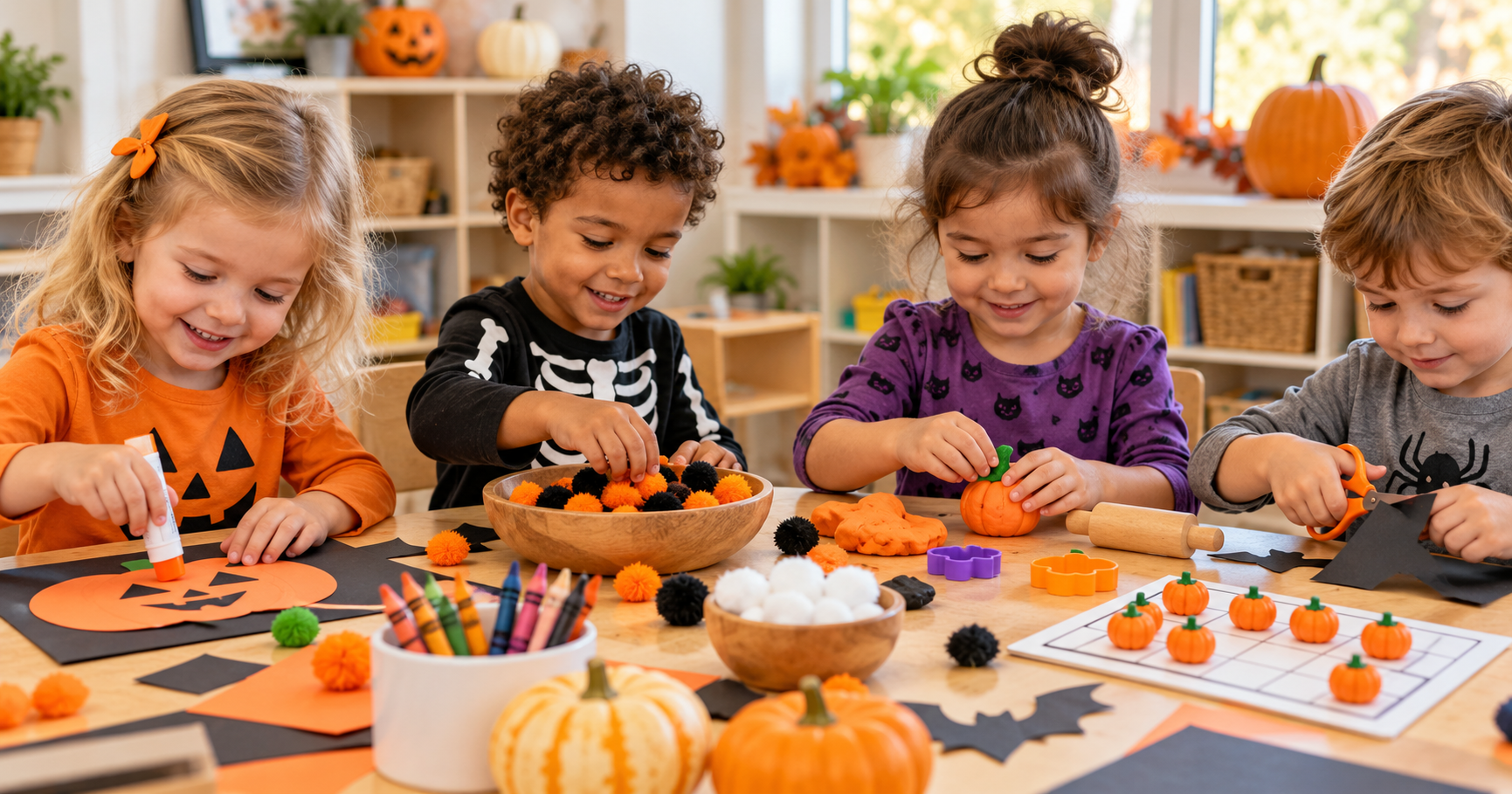
Halloween activities for preschoolers do not need to involve complicated crafts, expensive supplies, or an hour of preparation after your child has gone to bed.
At this age, children usually get more from activities that let them touch, move, count, build, sort, pour, pretend, and create. The easiest activities are often the ones you can set up with paper, cups, blocks, playdough, pom-poms, or a pumpkin you already have at home.
These ideas are designed for children around ages 3 to 5 and can work at home, in preschool, or in daycare. Most take only a few minutes to prepare, and several can be repeated throughout October without feeling like the same activity.
Draw a large pumpkin face on a paper plate or piece of cardboard and cut an opening for the mouth. Give your child orange pom-poms, bottle tops, blocks, or rolled-up pieces of paper.
Call out a number and ask them to “feed” the pumpkin that many pieces. Start with numbers from 1 to 5 for younger preschoolers and move up to 10 or 20 if your child is ready.
This turns simple counting into a game and gives children something physical to do with each number.
Write numbers on small paper pumpkins and create another set with matching dots.
Your child can match the number 4 to the pumpkin showing four dots, for example. If counting activities are working well for your child, you can also try an apple counting activity for preschoolers and simply change the theme depending on the season.
Draw several simple spider bodies on paper and write a number inside each one. Ask your child to add the correct number of legs using crayons, craft sticks, pipe cleaners, or strips of paper.
It does not need to look perfect. The learning comes from counting carefully and connecting the number to a quantity.
Place a few small pumpkins in a bowl or plastic container with warm water, a sponge, and an old toothbrush.
Let your child wash, scrub, rinse, and dry them.
This is one of the easiest Halloween activities to set up, but preschoolers often stay with it longer than adults expect. It supports fine motor skills, pretend play, and sensory exploration without requiring a finished craft.
Fill a container with dry pasta, rice, shredded paper, or large pom-poms. Add plastic spiders, toy pumpkins, scoops, cups, and tongs.
Ask your child to find all the spiders, sort objects by color, fill different containers, or count what they discover.
Always choose materials that are safe for your child’s age and supervise closely, especially if your child still puts small objects in their mouth.
Give your child orange, black, purple, or green playdough with safe accessories such as large googly eyes, craft sticks, cookie cutters, or bottle caps.
Instead of telling them exactly what to make, ask, “What Halloween creature can you create?”
Open-ended play usually keeps preschoolers engaged longer than trying to copy a perfect example. You can also build on existing playdough activities for preschoolers by adding a few Halloween-themed materials.
Hide paper pumpkins around the room or garden and ask your child to find them.
For an extra learning element, put a number, letter, shape, or color on each pumpkin. When your child finds one, ask them to identify it before searching for the next.
This works particularly well when a child has plenty of energy, but you still want the activity to have a learning purpose.
Call out different characters and let your child decide how they should move.
They might stomp like a monster, fly like a bat, crawl like a spider, or tiptoe like a cat.
You can make the game more useful by adding simple instructions such as, “Take three monster steps,” or “Fly to something orange.”
Draw pumpkin faces on empty plastic bottles or paper cups and stand them up like bowling pins.
Use a soft ball and let your child try to knock them over.
After each turn, count how many fell and how many are still standing. This gives children movement and number practice without making the activity feel like a lesson.
Draw a pumpkin outline on paper and give your child pieces of orange paper to tear into smaller pieces.
Let them glue the pieces inside the pumpkin.
Tearing paper is surprisingly good fine motor practice for young children because it strengthens the fingers they later use for drawing and writing.
Draw a simple ghost outline and let your child cover it with cotton balls.
They can add eyes and a mouth with paper or crayons.
Keep the activity relaxed. Preschool art does not need to look like the adult example. Letting children decide where materials go gives them more ownership over what they create.
Cut several pumpkin shapes from orange paper. Give your child large paper eyes, mouths, noses, eyebrows, and other facial features.
Ask them to create a happy pumpkin, surprised pumpkin, angry pumpkin, or sleepy pumpkin.
This gives you a natural opportunity to talk about emotions while your child plays.
Gather safe household items in orange, black, green, purple, and white.
Ask your child to sort them into groups.
You can use socks, blocks, toy cars, plastic cups, paper, or anything else you already have. Once everything is sorted, ask questions such as, “Which color has the most?” or “Which group has fewer?”
Use blocks, stickers, paper shapes, or pom-poms to create a simple pattern such as orange, black, orange, black.
Ask your child what should come next.
Once they understand the idea, let them create a pattern for you to finish.
Use blocks, cardboard boxes, toy people, and small pumpkins to create a pretend pumpkin patch.
Your child can build fences, make a pumpkin stand, count pumpkins, drive toy vehicles through the patch, or pretend customers are visiting.
This kind of activity works well because it combines building, storytelling, counting, and imaginative play without requiring children to sit and complete one specific task.
Preschoolers do not need a packed Halloween schedule to enjoy the season. Choose one activity, set out a few materials, and see what your child does with them.
If an activity lasts five minutes, that is fine. If your child turns your counting game into pretend play, that is fine too. At this age, the goal is not to produce perfect Halloween crafts. It is to give children opportunities to explore, practise skills, move their bodies, and enjoy learning.
If you are planning activities throughout the school year, our September preschool activities can also give you ideas for turning simple seasonal themes into hands-on learning without complicated preparation.