Physical Address
381 Myrtle Avenue, Brooklyn, NY 11205
Physical Address
381 Myrtle Avenue, Brooklyn, NY 11205
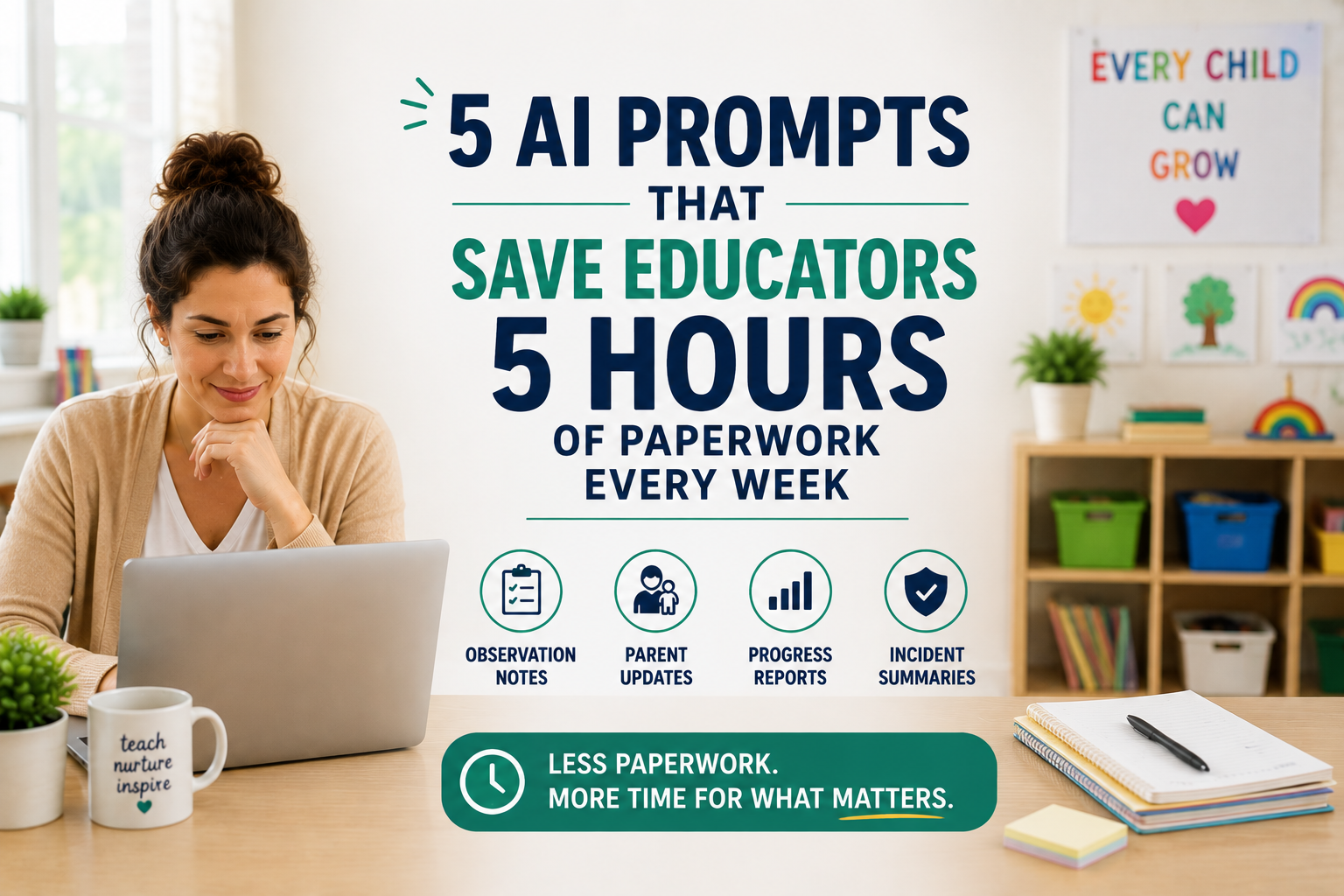
While every classroom and workload is different, using repeatable AI workflows across daily documentation can significantly reduce the time educators spend drafting paperwork each week.
You became an early childhood educator to teach, nurture, observe, and help young children grow.
Not to spend your evenings rewriting classroom notes.
Yet after the children leave, there are still daily observations, parent updates, progress reports, incident summaries, activity reflections, and other documentation waiting to be completed.
A quick classroom note such as:
“Child A tried scissors today. Needed help at first. Tried again and cut paper independently.”
may take seconds to record.
Turning dozens of notes like this into polished, professional documentation is another story.
This is where AI tools for early childhood educators can help.
Used responsibly, tools such as ChatGPT can take the observations you have already made and help you organize them into clearer first drafts. The goal isn’t to replace your professional judgment. It is to reduce repetitive writing so you can spend more of your time where it matters most: with children.
Below are five copy-and-paste AI prompts designed for some of the most time-consuming ECE documentation tasks.
AI is most useful when you treat it as a writing assistant rather than an educator.
You still:
AI can help with the next part: turning your rough notes into organized language.
Instead of staring at a blank screen wondering how to phrase an observation, you give the AI the facts and ask it to produce a first draft.
Then you review, correct, personalize, and approve it.
That simple workflow can make documentation much more manageable.
Daily observations are essential in early childhood education, but writing them clearly for every child can quickly become repetitive.
Start with rough notes instead.
For example:
“Child A stacked 8 blocks. Tower fell. Tried again twice. Asked friend for another block. Smiled when finished.”
Then use this prompt.
“Act as an early childhood education documentation assistant. Turn the anonymized classroom observation below into a concise, professional observation note for an early childhood portfolio. First describe only what was actually observed. Then briefly identify possible areas of learning demonstrated or supported by the experience. Use warm, objective, strengths-based language. Do not diagnose the child, invent details, or claim that one observation proves mastery of a developmental milestone.
Child’s age: [AGE]
Observation: [PASTE RAW NOTES]
Possible learning focus: [OPTIONAL]”
You now have a structured first draft without writing every sentence from scratch.
Time-saving tip: Keep this prompt saved somewhere easily accessible and replace only the observation each time.
Writing for parents requires a different tone from internal classroom documentation.
Parents generally don’t need a paragraph packed with professional terminology. They need to understand:
What happened? What is my child learning? Why does it matter?
AI can help translate educator notes into clear, family-friendly language.
“Turn the anonymized observations below into a warm, professional progress update for a child’s family. Organize the information around strengths, emerging skills, interests, and areas we are continuing to support. Use simple language a parent can easily understand. Include specific evidence from my observations rather than generic praise. Do not diagnose, exaggerate progress, or add information I did not provide. End with one practical way we will continue supporting the child’s learning in the classroom.
Age: [AGE]
Observation 1: [PASTE NOTE]
Observation 2: [PASTE NOTE]
Observation 3: [PASTE NOTE]
Current classroom focus: [OPTIONAL]”
This is particularly useful when preparing weekly updates, portfolio summaries, or parent-teacher conferences.
Incident documentation can be one of the hardest things to write.
You need to explain what happened accurately without labeling the child or using unnecessarily emotional language.
Words such as “naughty,” “aggressive,” “out of control,” or “bad behavior” can turn an observation into a judgment.
Instead, document observable actions, educator responses, and what happened next.
“Rewrite the anonymized incident notes below into a factual, neutral, non-punitive incident summary for an early childhood setting. Clearly state what was observed, the relevant context I provided, how the educator responded, and what happened afterward. Use objective language and do not label the child’s character, speculate about motives, minimize the incident, diagnose the child, or invent details. Keep the wording calm and professional.
Age: [AGE]
What happened: [PASTE FACTUAL NOTES]
Educator response: [WHAT STAFF DID]
Outcome: [WHAT HAPPENED NEXT]”
For example, instead of:
“Child C got angry and attacked another child because he wouldn’t share.”
you might document the observable event:
“During free play, Child C and another child reached for the same truck. Child C struck the other child with an open hand. An educator intervened, separated the children, checked both children, and supported Child C in practicing words to request a turn.”
The goal isn’t to make a serious incident sound nicer.
The goal is to make the documentation accurate, objective, and useful.
You may have plenty of observations but still struggle when it is time to create a longer developmental summary.
This is where AI can be especially useful.
Instead of asking AI to determine a child’s development independently, ask it to organize patterns already present in your observations.
“Review the anonymized classroom observations below and organize them into a concise early childhood progress summary. Group repeated evidence under relevant themes such as social-emotional development, communication, physical development, independence, problem-solving, creativity, and play. Only make statements supported by the observations provided. Clearly distinguish between repeated patterns and single observations. Do not diagnose the child or invent developmental milestones. End with 2 possible classroom next steps based on the evidence.
Age: [AGE]
Observations:
[PASTE ANONYMIZED NOTES]”
This can help transform a page of disconnected notes into a much more useful starting point for your report.
A learning story goes beyond saying what a child did.
It helps families understand the learning taking place through everyday play and exploration.
“Turn this anonymized classroom observation into a 3-to-5 sentence learning story for a child’s family. Begin with what the child actually did. Highlight possible learning demonstrated or supported through the experience, using accessible language rather than heavy academic jargon. Mention any educator support that I provide in the notes. Finish with one possible next step for extending the learning. Keep the tone warm and strengths-based, but do not exaggerate, diagnose, or invent details.
Age: [AGE]
Observation: [PASTE RAW NOTE]
Educator support: [OPTIONAL]
Learning focus: [OPTIONAL]”
This gives you a draft that can be edited to match the child’s personality, your classroom voice, and your program’s documentation framework.
Saving time should never come at the expense of children’s privacy.
For U.S. educators working in settings subject to FERPA, education records and personally identifiable information require careful handling. FERPA does permit certain disclosures to third parties performing institutional services under the “school official” exception, but specific conditions apply, including requirements concerning the school’s control over the third party and how personally identifiable information is used.
That means educators should not independently assume that any AI tool is approved for identifiable student records.
Before using an AI tool:
The AI product and account type also matter.
For example, OpenAI states that data from ChatGPT Business, Enterprise, Edu, ChatGPT for Teachers, and its API platform is not used to train its models by default. Personal ChatGPT workspaces have different data controls, including the ability to opt out of having new conversations used for model improvement.
OpenAI also states that its security and privacy controls support customers’ compliance with FERPA, among other privacy requirements. That does not, however, mean every educator’s use of every ChatGPT account automatically complies with FERPA. Your institution’s policies, configuration, contracts, permissions, and specific use still matter.
There is one instruction worth adding to almost every ECE prompt:
“Do not invent information that isn’t contained in my notes.”
AI can produce polished language.
The problem is that polished language can sound credible even when an interpretation goes beyond what you actually observed.
Your notes are the evidence.
AI creates the draft.
You make the professional judgment.
They can reduce the amount of time spent drafting repetitive documentation, but there is no universal five-hour guarantee.
The biggest savings are likely to come from using a repeatable workflow across several recurring tasks:
Raw observation → AI first draft → Educator review → Final documentation
Imagine reducing the drafting time required for:
Even a few minutes saved repeatedly throughout the week can add up.
And for an educator already taking documentation home, that time matters.
The best AI tools for early childhood educators shouldn’t make classrooms less human.
They should make unnecessary administrative work less burdensome.
AI doesn’t notice the quiet child who finally joins a group activity.
It doesn’t see the toddler who tries a puzzle four times before succeeding.
It doesn’t know why today’s two-word request represents meaningful progress for a particular child.
You do.
Your observations, relationships, and professional judgment remain at the center of quality early childhood education.
Let AI help organize the words.
Then spend the time you save doing the work only an educator can do.