Physical Address
381 Myrtle Avenue, Brooklyn, NY 11205
Physical Address
381 Myrtle Avenue, Brooklyn, NY 11205
If you teach toddlers or preschoolers, you probably collect dozens of small observations throughout the day.
Your notes might look something like this:
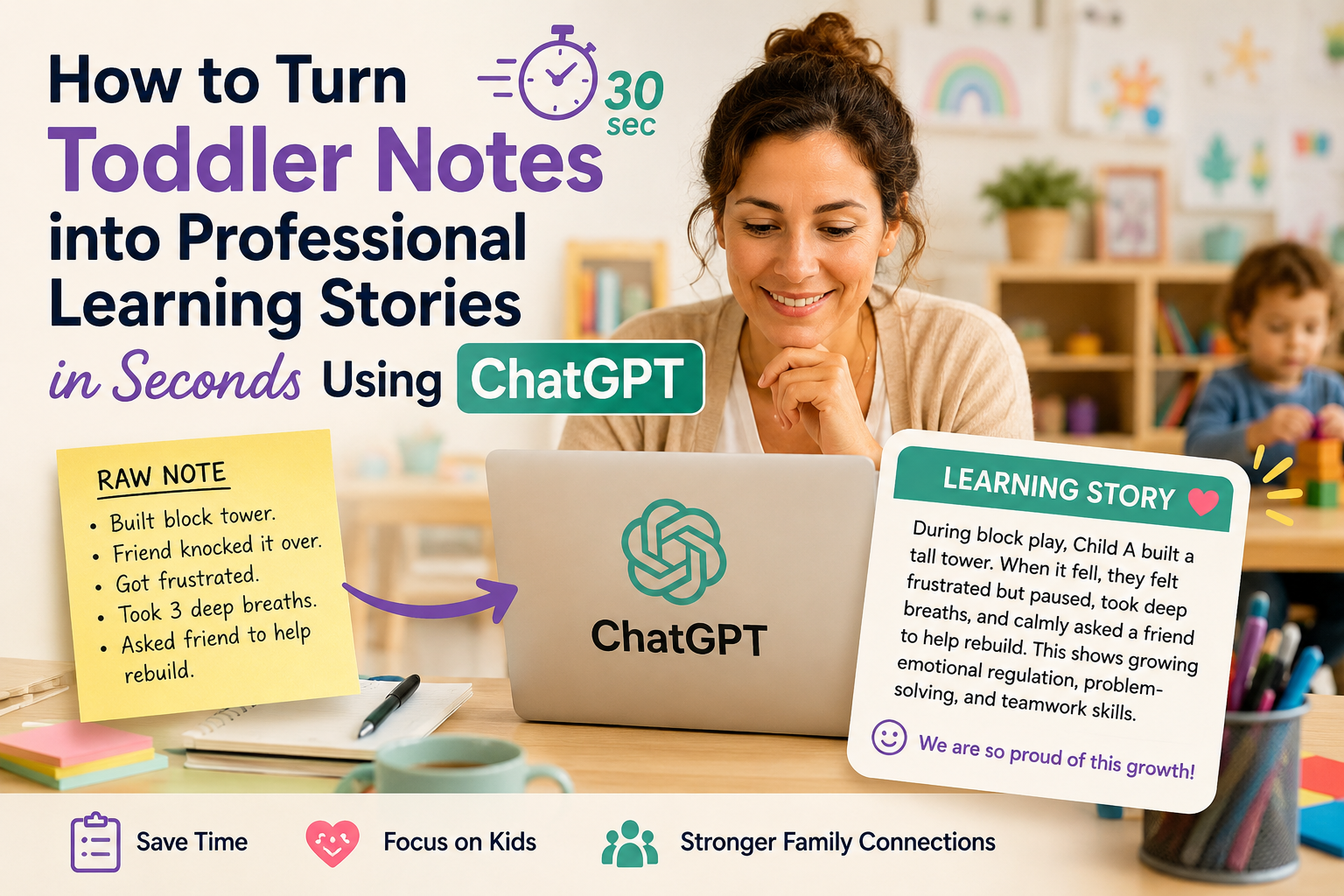
“Child A built a block tower. Another child knocked it over. Child A became upset, paused, took three deep breaths like we practiced, then asked for help rebuilding.”
That quick note contains valuable information about emotional regulation, communication, problem-solving, and peer interaction.
The challenge comes later.
How do you turn a few hurried notes into a warm, professional learning story that parents can understand—without spending your entire planning period writing?
One option is to use ChatGPT to help with the drafting.
With a simple prompt, early childhood educators can turn rough classroom observations into organized learning-story drafts in seconds, then review and personalize them before sharing with families.
Here is how.
A learning story is a narrative form of observation and documentation that captures what a child did, what the educator noticed, and what the experience may reveal about the child’s learning and development.
Rather than simply writing:
“Child A played with blocks.”
A learning story gives parents more context about what happened and why the experience was meaningful.
For example:
“During block play today, Child A worked carefully to build a tall tower. When the tower fell, Child A initially became frustrated but used the calming strategy we have been practicing before asking a friend to help rebuild it. This experience gave Child A an opportunity to practice emotional regulation, communication, and cooperative problem-solving.”
The second version helps families see the learning behind the play.
For busy toddler and preschool teachers, however, creating this level of documentation for multiple children can become time-consuming.
That is where ChatGPT can help.
Yes, but it should be used as a drafting assistant, not as a replacement for teacher observation or professional judgment.
You observe the child.
You record what actually happened.
ChatGPT helps organize those notes into clear language.
You then review the draft, correct anything the AI misinterpreted, and ensure the final documentation accurately reflects the individual child.
This distinction matters because authentic observation and documentation in early childhood education should be based on what educators actually see, hear, and record—not developmental conclusions invented by AI.
Before entering classroom information into ChatGPT or any other AI tool, follow your school, center, district, and applicable privacy policies.
Do not assume that removing a surname automatically makes information safe to share.
As a general rule, avoid entering unnecessary personally identifiable or sensitive information such as:
A safer workflow is to use placeholders such as Child A, Child B, or Child C and add identifying information only after the final draft has been moved into your approved documentation system.
If your program has an approved AI platform or specific AI policy, follow those requirements first.
You do not need to write perfect sentences before asking ChatGPT for help.
Start with what teachers already do well: observe and jot down what happened.
Start a ChatGPT conversation with a reusable prompt like this:
Prompt:
“Act as an early childhood education writing assistant familiar with developmentally appropriate, play-based practice. I will provide brief, anonymized classroom observations. Turn each observation into a warm, objective 3–4 sentence learning-story draft for families. Describe what the child did before connecting the observation to possible areas of learning. Use strengths-based language and avoid diagnosing, exaggerating, or claiming that a single observation proves a developmental milestone. Do not invent details that are not in my notes. End with one possible next step the educator could use to extend the learning.”
That final instruction is important.
You do not want ChatGPT making up developmental achievements simply because they sound impressive.
Your notes do not need to be polished.
Use a simple structure:
Child: Child A
Age: 3 years
Observation: Built a tall block tower. Tower fell. Became frustrated. Used breathing card. Asked another child to help rebuild.
Possible learning focus: Emotional regulation and cooperative play.
Then ask:
“Turn this observation into a parent-friendly learning story.”
ChatGPT might produce something like:
“During block play today, Child A worked carefully to build a tall tower. When the tower fell, Child A became frustrated but paused to use the breathing strategy we have been practicing before asking another child to help rebuild. This experience offered opportunities to practice emotional regulation, communication, and cooperative problem-solving. We can continue supporting this growth by providing collaborative building activities and opportunities to practice calming strategies during play.”
Now comes the most important step:
Review it before sharing it.
Ask yourself:
Once those checks are complete, edit the story as needed and add it to your approved classroom documentation or parent communication system.
Here are three reusable prompts for common early childhood documentation situations.
Raw note:
“Child B held safety scissors using a thumb-up grip. Cut several paper strips independently. Stayed focused on activity.”
ChatGPT prompt:
“Turn this anonymized preschool observation into a short, parent-friendly learning story. Describe what happened objectively and explain how the activity may support fine motor development and independence. Do not add details I did not observe.”
The result can give you a polished starting point for a portfolio or parent update.
Behavior-related documentation requires particular care.
Avoid labeling a child as “aggressive,” “bad,” “difficult,” or “naughty.” Focus instead on what was observed, how the teacher responded, and what skills are being supported.
Raw note:
“Child C hit another child when both wanted the red truck. Teacher intervened, reminded Child C about gentle hands, and helped both children practice asking for a turn.”
Prompt:
“Rewrite this observation objectively and constructively for a parent. Do not minimize what happened, but use neutral, nonjudgmental language. Explain the social-emotional skills we are supporting and what the teacher did to help.”
A draft might read:
“During free play today, Child C and another child both wanted to use the same truck. When the interaction became physical, an educator stepped in and supported Child C in using gentle hands and practicing words to request a turn. We are continuing to provide opportunities to practice communication, turn-taking, and managing strong emotions during peer play.”
Notice that the incident has not been hidden.
It has simply been documented professionally.
ChatGPT can also help organize several weeks of observations into one coherent draft.
For example:
Prompt:
“Using only the observations below, create a concise developmental portfolio summary for a preschool parent-teacher conference. Group repeated evidence into themes such as communication, social-emotional development, motor development, problem-solving, and play. Mention patterns you can support with multiple observations. Do not diagnose the child or invent milestones. Identify one or two possible next steps for classroom support.[Paste anonymized observations]”
This can be especially useful when you have accumulated multiple anecdotal notes and need help identifying patterns across them.
Typing is not your only option.
If voice input is available in the ChatGPT experience you use, you can dictate an anonymized observation instead.
For example:
“Turn this into a short learning-story draft. Child E recognized the letters in their name during morning sign-in and then helped another child locate a cubby label.”
ChatGPT can organize the observation into a draft while the details are still fresh in your mind.
However, the same privacy rules apply to spoken information.
Do not dictate sensitive or personally identifiable student information unless your school has specifically approved the tool and workflow you are using.
For consistent results, use this simple formula:
Observation → Learning → Teacher Support → Possible Next Step
What did you actually see or hear?
What skills or learning areas might the observation demonstrate or support?
What did the educator do to encourage or extend the experience?
What could you provide next to continue the child’s exploration or skill development?
This structure keeps the documentation focused on the child rather than turning the learning story into generic AI-generated praise.
ChatGPT can help you draft, organize, summarize, and improve the wording of your notes.
But there are important things it should not be trusted to do independently.
Do not use ChatGPT to diagnose a child.
Do not ask it to determine whether a toddler has autism, ADHD, a speech delay, or another developmental condition based on classroom notes.
Do not let AI invent observations.
If you did not observe it, it should not appear in the child’s documentation.
Do not treat one observation as proof of mastery.
A child doing something once may provide useful evidence, but development should be understood through ongoing observation over time and in context.
Do not copy AI output without reviewing it.
AI-generated language can sound convincing even when it overinterprets an observation.
Your professional judgment still comes first.
ChatGPT can help turn anonymized daycare observation notes into clearer, parent-friendly drafts. The educator should provide the factual observation, review the AI-generated wording, remove unsupported claims, and ensure the final version follows the program’s privacy and documentation policies.
Yes. Teachers can provide anonymized notes describing what they observed and ask ChatGPT to organize them into a narrative learning-story format. The final story should still be reviewed and edited by the educator.
A useful learning story typically describes what happened, highlights meaningful learning or engagement, reflects on what the educator noticed, and may identify opportunities to extend the child’s learning.
Educators should follow their organization’s approved AI and student-data policies. Avoid entering unnecessary identifying or sensitive student information into personal AI accounts. When possible, anonymize observations before using AI and add identifying information later within the school’s approved system.
ChatGPT can help organize or improve the wording of educator-created notes, but it should not independently assess, diagnose, or make high-stakes developmental decisions about a child. Formal assessment should follow your program’s approved practices and be completed by appropriately qualified professionals.
The goal of using AI in early childhood education should not be to automate your knowledge of children.
That is the part technology cannot replace.
You notice when a toddler finally uses words instead of grabbing.
You see the concentration required to complete a difficult puzzle.
You recognize the small changes in confidence, independence, communication, and friendship that may be invisible to everyone else.
ChatGPT can simply help you turn those raw toddler observation notes into clear, professional learning-story drafts faster.
Observe the child yourself.
Record what actually happened.
Let AI help with the first draft.
Then use your professional judgment to make the story accurate, meaningful, and worth sharing with the family.