Physical Address
381 Myrtle Avenue, Brooklyn, NY 11205
Physical Address
381 Myrtle Avenue, Brooklyn, NY 11205

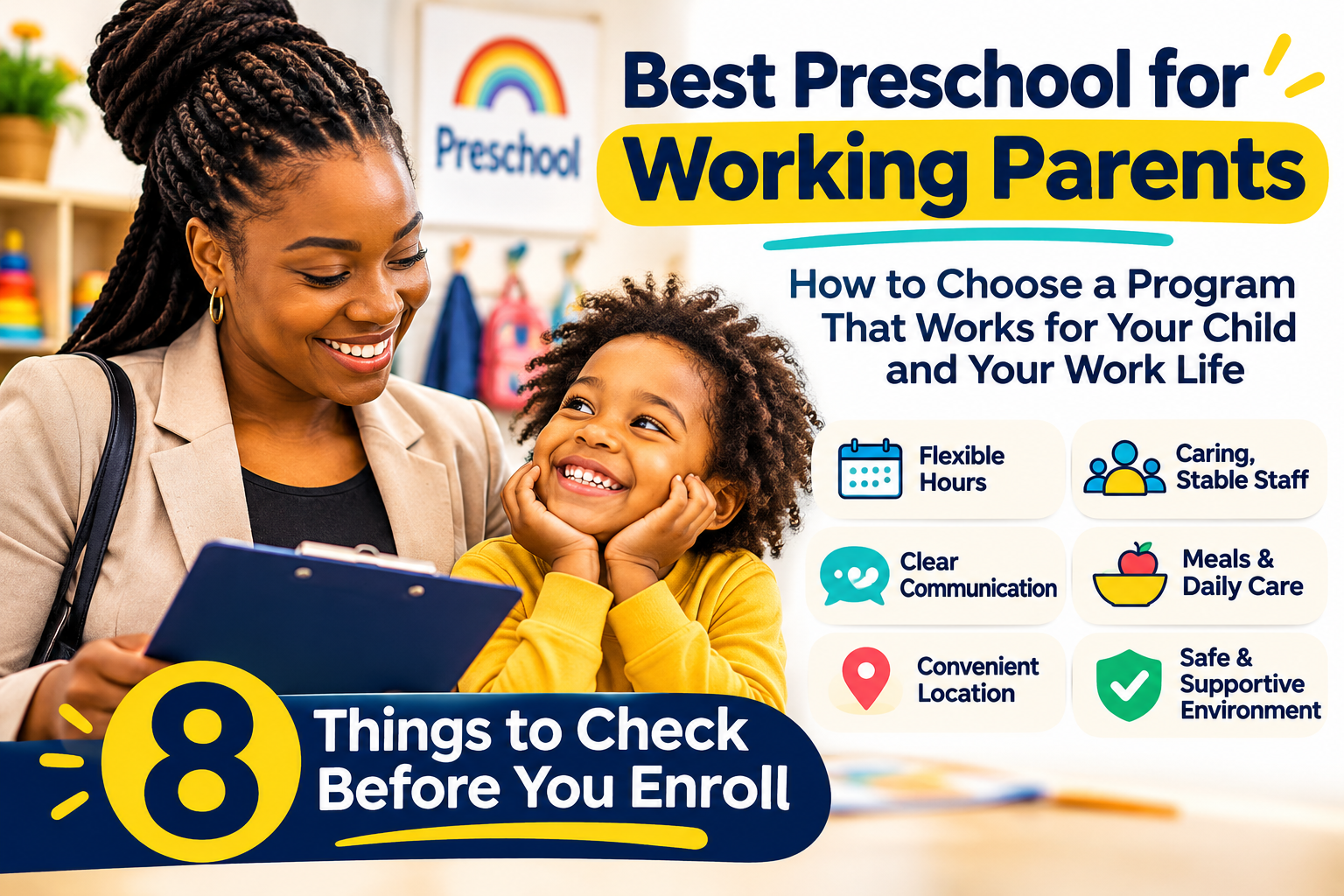
A preschool can have beautiful classrooms, impressive learning materials, and glowing reviews and still be completely wrong for a working family.
If pickup is at 3:00 p.m. but you finish work at 5:00, the curriculum is not your biggest problem.
For working parents, the best preschool is not simply the one that looks most academic. It is the one that keeps your child safe and supported while also fitting realistically around your workday.
If you are comparing preschools, daycare centers, or flexible child care options, these are the things worth looking at before you enroll.
Before asking about phonics, art activities, or school-readiness programs, ask one practical question:
Can these hours actually work with my job?
Check:
A preschool that closes at 3:30 p.m. may work beautifully for one family and create daily stress for another.
For parents with long commutes, shift work, hybrid schedules, or unpredictable finishing times, flexible child care may matter just as much as the classroom itself.
Working parents often discover this problem too late.
Ask for the full calendar before enrolling.
Look at:
Then ask whether tuition is still charged when the preschool is closed.
A program may look affordable until you realize you will also need backup care several times each year.
During a tour, spend less time looking at the decorations and more time watching the adults.
Do teachers get down to children’s level when speaking with them?
Do they comfort upset children?
Are children being redirected calmly, or are adults constantly shouting instructions across the room?
Do teachers seem to know individual children’s personalities and routines?
A polished classroom does not tell you nearly as much as watching what happens when a child cries, refuses to share, spills something, or struggles to join an activity.
For many parents, these ordinary moments reveal more about a preschool than the planned tour presentation.
This question is easy to overlook:
“How long have your current teachers been here?”
Young children build relationships with the adults who care for them. Constant staff changes can mean children repeatedly have to adjust to new faces, expectations, and routines.
You do not necessarily need a preschool where every teacher has worked there for ten years.
But if several staff members have recently left, it is reasonable to ask why.
Every child will not happily walk into preschool every morning.
Ask:
“What happens if my child is crying and does not want me to leave?”
You are listening for something more thoughtful than, “They’ll be fine.”
A good answer should tell you how staff help children separate, settle into an activity, receive comfort, and gradually become familiar with the routine.
If your child already finds change difficult, you may also want to read why toddlers struggle with daycare transitions before choosing a program.
The best preschool for your family should have a realistic plan for supporting children through adjustment, not simply expecting them to stop crying.
When you are at work, you should not spend the day wondering whether your child ate lunch, slept, participated, or spent three hours upset.
Ask how the preschool communicates with parents.
Some programs use apps. Others send messages, daily reports, photos, or brief updates at pickup.
More communication is not automatically better, but you should know how important information will reach you.
Also ask what happens when there is a behavior concern, injury, illness, or recurring problem.
Working parents need useful communication without requiring them to answer their phones throughout the workday.
These details may sound small during a preschool tour.
They will not feel small when they affect your child every day.
Ask:
You want to understand how the preschool handles normal childhood needs, not just structured learning time.
If eating is already a concern for your child, our guide on child won’t eat at daycare can help you prepare questions before enrollment.
A preschool that is 25 minutes away may not sound unreasonable.
But that is potentially 50 minutes of extra travel every day, five days a week.
Think about where the preschool sits in relation to your home, workplace, train station, or usual commute.
Then imagine doing the journey in traffic, rain, during a stressful morning, or when you are already running late.
Convenience should not be the only factor when choosing child care, but for working parents, it deserves more weight than people sometimes give it.
Before enrolling, you should be able to answer these questions:
Does the schedule fit my actual workday?
Do I understand the holidays and closures?
Do I trust the way staff interact with children?
Is staff turnover reasonable?
How will they help my child settle in?
How will they communicate with me?
Can they accommodate my child’s everyday needs?
Can I realistically manage the commute every day?
If several answers make you uneasy now, they probably will not become less stressful once you are paying tuition and trying to get to work on time.
Working parents are sometimes made to feel as though choosing a preschool should be entirely about the child’s educational experience.
Of course, quality matters.
But your family’s routine matters too.
A preschool that supports your child beautifully while making your workday almost impossible is not truly the best fit.
The strongest choice is usually the program where safety, nurturing relationships, learning, communication, location, and practical flexibility come together.
You are not looking for a perfect preschool.
You are looking for one where your child can thrive and where your family can realistically function Monday through Friday.