Physical Address
381 Myrtle Avenue, Brooklyn, NY 11205
Physical Address
381 Myrtle Avenue, Brooklyn, NY 11205

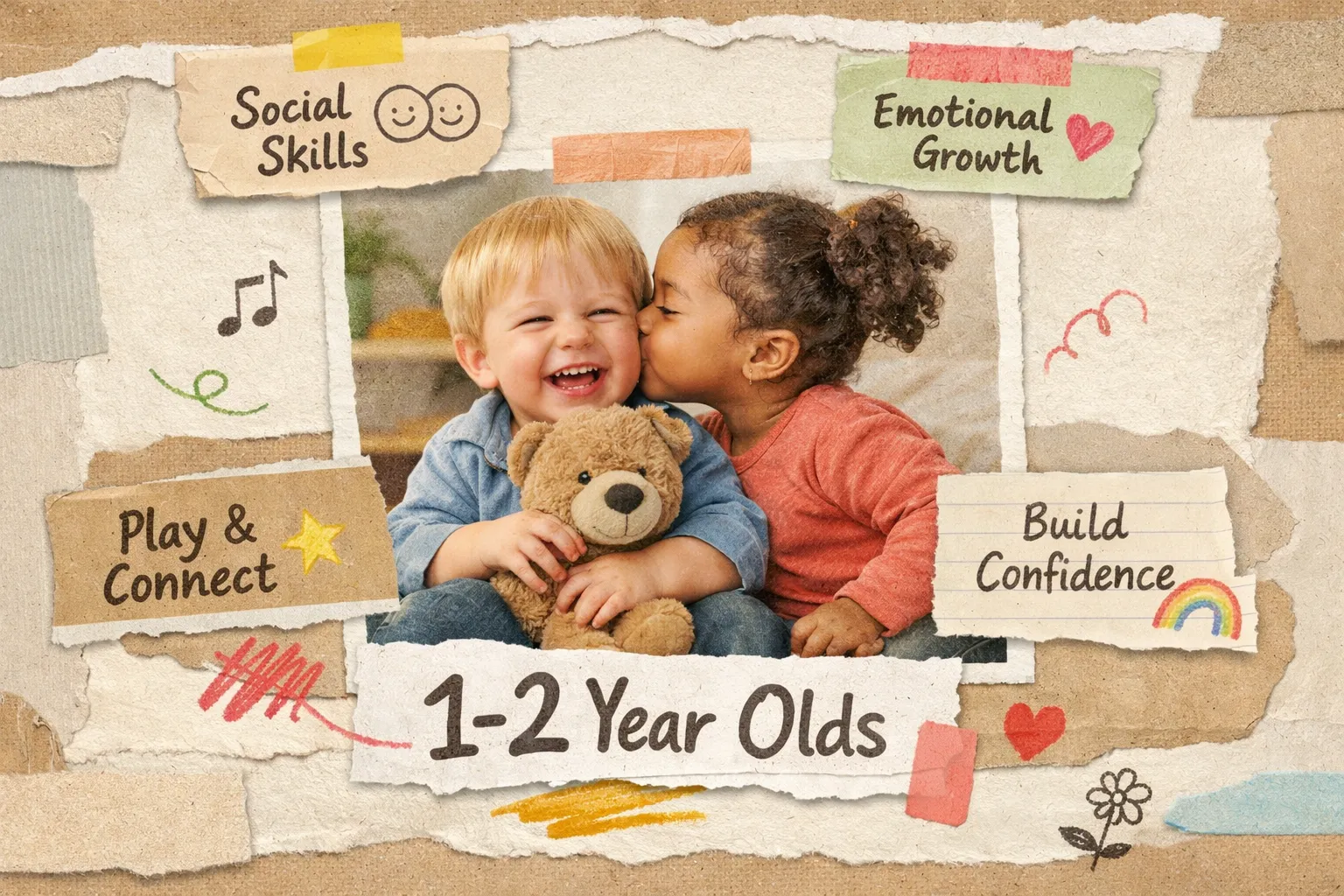
Picture this: your toddler reaches for a toy, another child grabs it first, and your little one dissolves into tears on the floor. You watch, unsure whether to intervene, redirect, or simply wait it out. Most caregivers in that moment feel a quiet helplessness, wanting to do something that actually helps rather than just survive the next sixty seconds.
The good news is that social and emotional development activities for 1- and 2-year-olds don’t require a curriculum, a special kit, or a dedicated “learning time” slot in your day. It happens in the mirror at breakfast, during a five-minute ball roll on the living room rug, and in the words you use when your child’s block tower falls over. At Mindset Moment, this is exactly the kind of practical, daily approach we help caregivers build into their routines. This article walks you through specific activities grouped by skill area, the language to use in the moment, and a realistic way to fit all of it into an ordinary day.
Before starting these activities, it helps to understand what’s actually happening developmentally so you’re building on what’s already there rather than pushing toward something that isn’t. For practical, age-specific guidance and parent-friendly explanations, see our Child Emotional Development Archives, Mindset Moment.
Children in this window are social in a quiet but real way. They hand objects to others as a form of play, show affection toward familiar people, and enjoy simple pretend sequences like feeding a doll or offering a cup to a stuffed animal. They explore independently but check back frequently to make sure a caregiver is nearby, which is a sign of secure attachment rather than clinginess.
Early empathy also shows up here. A 14-month-old who pauses and looks worried when they hear another child cry is demonstrating the kind of emotional responsiveness these activities are designed to deepen. These behaviors signal a child who is ready for simple back-and-forth interactions and for hearing emotion words tied to real moments. This is the ideal stage to begin parent-child bonding activities for toddlers that keep the stakes low and the repetition high.
This is the stage when caregivers often feel like their sweet toddler has been replaced by a tiny negotiator. “Mine,” “no,” and “I do it” arrive in full force because children are asserting a new sense of self. That’s developmental progress, even when it’s exhausting. The emotional range also expands significantly: anger, sadness, fear, and excitement become more visible and more intense.
Self-recognition in mirrors and photos typically emerges between 18 and 24 months, which is why mirror-based activities land especially well in this window. Research on toddler self-recognition suggests this self-awareness is associated with later emotional understanding, though it’s worth knowing that the connection is correlational rather than a simple cause-and-effect. Children are also beginning to shift from playing alongside peers (parallel play) to brief back-and-forth exchanges. Tantrums increase at this stage not because something is wrong, but because toddlers are feeling far more than they can say. Activities that build emotion vocabulary directly address the gap between what they feel and what they can express.
Research on caregiver emotion coaching and labeling consistently links early emotion vocabulary to better self-regulation and fewer behavioral challenges in the preschool years. That said, this isn’t about accelerating development. It’s about meeting your child where they already are and giving them words and tools for what they’re already experiencing. These toddler SEL activities are most effective when they feel like play, because for children this age, they are.
The skills that take root now, through small repeated moments, are the ones children carry into group settings, friendships, and the classroom. Starting early isn’t about pressure; it’s about presence.
Sit together in front of any mirror, make an exaggerated expression, name it clearly, and invite your child to copy. Say things like “That’s your happy face! See your big smile?” or “I’m making a sad face. Can you make a sad face?” This activity works because it connects a physical sensation (the muscles in the face moving) to a word, in real time, with no materials required. A short session at the bathroom mirror during the morning routine is plenty. Early childhood educators often recommend keeping sessions like this to 5-10 minutes for this age group, with repetition across multiple days doing the heavy lifting.
Draw four simple faces on paper plates or print a basic set of feeling cards with happy, sad, angry, and scared. Hold one up, name the feeling, and ask your child to make that face. Then connect it to a real memory: “Remember when we went to the playground and you went down the big slide? You looked just like this.” Keep these sessions to 5-10 minutes for 1-year-olds and up to 15 minutes for 2-year-olds. Repetition over several days matters far more than getting it right the first time.
Act out an emotion using only your face and body: stomp your feet for angry, slump your shoulders for sad, jump for excited. Ask your toddler to guess, then switch roles so they get to perform while you guess. This activity builds nonverbal cue reading and gives toddlers a physical, whole-body way to express feelings before their vocabulary is there to support it. It’s one of the simplest social-emotional activities for toddlers because it requires nothing except a willing adult and a bit of silliness.
Both of these work for the same reason: they require a pause and a response. When you roll a ball and wait, your toddler learns that interactions have a rhythm, that their action (rolling it back) affects what happens next. Ball rolling in particular makes the concept of “your turn, my turn” completely concrete and physical, which is exactly right for children who aren’t yet ready for rule-based games. These are ideal starting points for the 12-18 month range.
Use two sock puppets, stuffed animals, or even your hands to act out a small conflict: both toys want the same block. Ask your toddler: “What should they do?” and act out whatever they suggest. This approach works well from around 18 months because children at this stage are beginning to understand cause and effect in social situations. It lets them practice empathy and problem-solving without any real emotional stakes in the moment.
Assign an emotion to a toy (“Bear is sad today, he lost his hat”) and ask your toddler to decide how to help. Should they give Bear a hug? Find the hat? Bring him a snack? Externalizing feelings onto a character is far less threatening than discussing your child’s own big emotions directly, which makes this a natural and gentle entry point. It also doubles as a calming wind-down activity before nap or bedtime.
Gather two or three soft pillows, a favorite stuffed animal, and optionally tape a simple feelings poster to the wall nearby. The corner isn’t a time-out space. You sit with your child there and name what’s happening: “You’re really angry right now. Let’s breathe together.” Introduce it during a calm moment first so your toddler learns to associate it with comfort rather than punishment, then let that positive association do the work over time. Once it clicks, they’ll start choosing it on their own.
Draw a circle on cardboard, divide it into four to six sections, color each section for a different emotion (yellow for happy, blue for sad, red for angry), and attach a paper arrow with a brad fastener so it spins. When the arrow lands on an emotion, your child acts it out. This works especially well with siblings or during a playdate because the group format adds a layer of social connection to the skill-building.
“If You’re Happy and You Know It” is more powerful than it looks. Extend it with new verses: “If you’re angry, stomp your feet” or “If you’re sad, wipe your eyes.” Songs give toddlers a structured, low-pressure format to connect physical actions to emotional states. Combining movement with emotion words supports vocabulary retention because toddlers learn through their whole bodies, not just their ears.
The most effective approach is to name what you observe before you assign the emotion: “I see you’re stomping your feet. Are you feeling angry?” or “You look frustrated that the blocks fell down.” This sequence (observable cue first, emotion word second) helps your child connect an inner state to language. Start with four core words: happy, sad, mad, and scared. Add more specific vocabulary like frustrated, excited, and surprised once those four are solid. For printable word lists and caregiver-friendly emotion vocabulary, consider the Emotion Words for Caregivers infographic.
When a prosocial moment happens, narrate the emotional impact rather than just praising the behavior. Instead of “Good sharing,” try “You shared the ball. Look how happy she is now.” When your child notices a friend is upset, prompt gently: “Your friend looks sad. How can we help?” This teaches the why behind prosocial behavior, not just the rule. That distinction is what creates lasting change.
Brief, calm self-disclosure is one of the most powerful things you can do. Say things like “I’m feeling a little frustrated right now. I’m going to take a breath” and then visibly do it. Toddlers learn co-regulation from watching caregivers regulate themselves, so modeling in small doses gives them a real template to work from. Keep it short, keep it calm, and let them watch you come back to baseline.
One-year-olds do best with 5-10 minute bursts of intentional play repeated throughout the day. Two-year-olds can sustain 15-20 minutes before attention fades. As a practitioner-aligned guideline, early childhood educators generally aim for about 180 minutes of varied daily activity for toddlers, though it’s worth noting this figure comes from physical activity recommendations (such as NHS guidance for under-5s) rather than structured SEL targets. In practice, that time includes free play, meals, transitions, and any moment when you narrate an emotion in real time. Structured social-emotional development activities for 1- and 2-year-olds are a small but meaningful part of a much larger, continuous learning environment.
At Mindset Moment, our toddler resources are built around exactly these ordinary moments: a mirror check-in during the morning routine, a feelings circle before snack, and a calm-down corner available throughout the day. Rather than isolated sessions, the goal is to weave social-emotional learning into the rhythm of daily life so it becomes second nature. You can borrow the same structure at home by anchoring one activity to an existing routine, such as the mirror game at tooth-brushing time or feelings charades before bath. Learn more from our Toddler Development Archives, Mindset Moment.
Progress in this age range is measured in small, consistent moments, not milestones hit on a schedule. A toddler who points to the sad face on a card, a 2-year-old who says “mad” instead of throwing something, a child who walks to the calm-down corner independently: these are real wins. Consistency over weeks matters far more than any single session. If you notice significant regression or a consistent absence of social interest after several weeks of regular practice, a conversation with your pediatrician is a reasonable and welcome next step, you can use the CDC’s 2-year milestones as a helpful reference when you do.
That toddler crying over the snatched toy isn’t showing a behavior problem. They’re showing you a child who hasn’t yet found the words for what they feel. The play-based, language-rich social and emotional development activities covered here give you a concrete daily way to teach those words, through mirrors and stuffed animals and songs and calm corners, in the ordinary moments that already fill your day. For strategies focused on everyday behavior in toddlers, check our Toddler Behavior Archives, Mindset Moment.
Pick one activity today and repeat it every day for a full week before adding a second. The emotion recognition work builds the foundation. Turn-taking activities build prosocial confidence alongside it. And the language you use in real time is what ties both together into something your child can actually use. These early habits form the emotional vocabulary children carry with them into preschool and beyond.
For more guidance on building readiness at home, explore Mindset Moment’s resources on preschool readiness checklists and daily learning routines. The skills you’re building right now, in five-minute increments, are exactly what your child needs for everything that comes next. Try one activity this week and notice what shifts. For a concise, age-specific overview of social-emotional milestones and activities for 12, 24 months, see Zero to Three’s 12, 24 months social-emotional development guide.