Physical Address
381 Myrtle Avenue, Brooklyn, NY 11205
Physical Address
381 Myrtle Avenue, Brooklyn, NY 11205

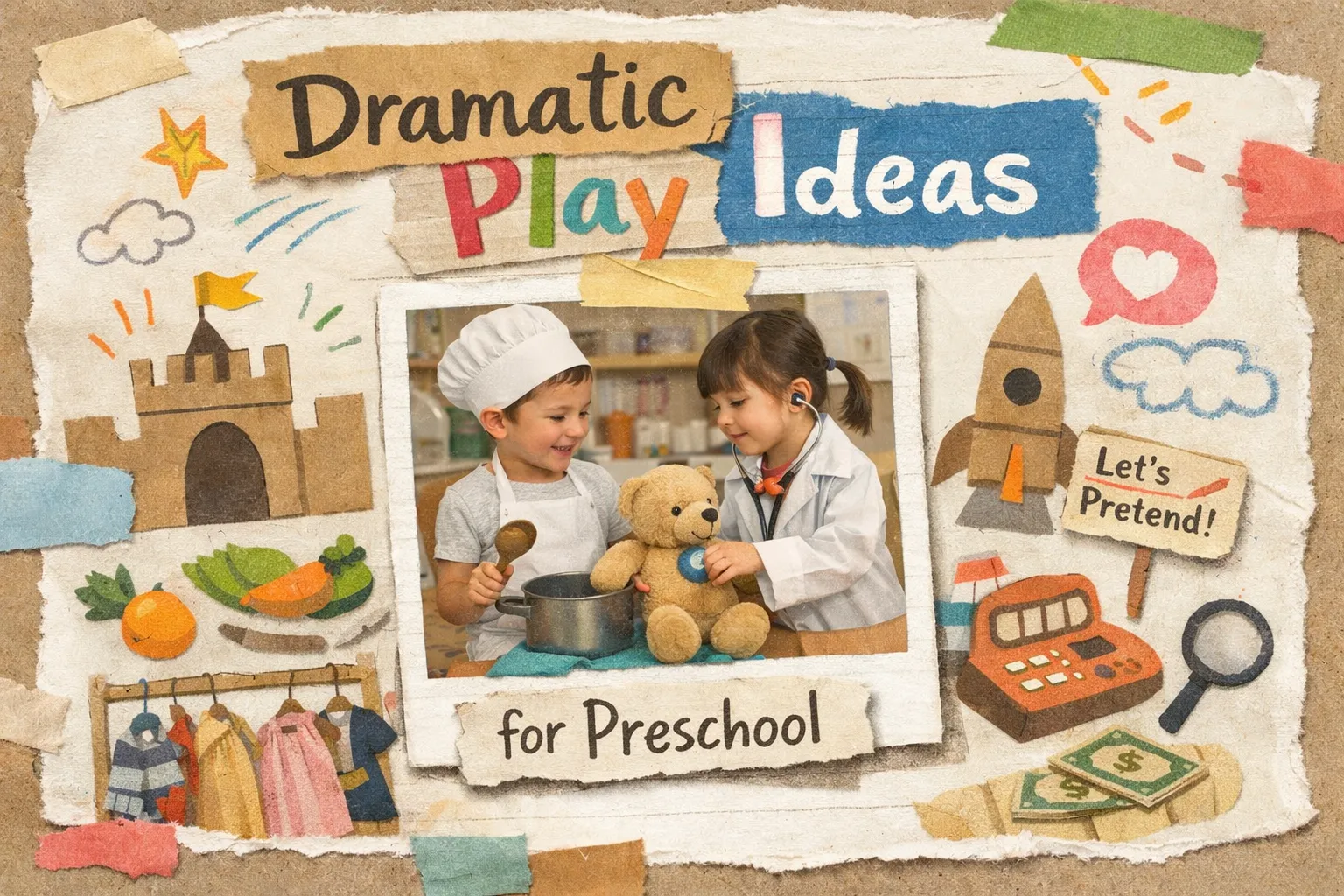
Give a preschooler a cardboard box, a toy phone, and a few pieces of paper, and that simple setup can quickly become a restaurant, doctor’s office, grocery store, or airport.
That is the power of dramatic play.
During dramatic play, children take on roles, recreate familiar experiences and invent their own stories. They might become a doctor caring for a stuffed animal, a parent preparing dinner, a shopkeeper helping customers or a teacher reading to a classroom of toys.
It may look like children are simply having fun, but they are also practising communication, cooperation, problem-solving, early literacy and creativity.
The best part is that dramatic play does not require expensive toys or complicated setups. Everyday household objects, recycled materials, dress-up clothes and a little imagination can create rich learning opportunities.
If you are looking for simple dramatic play ideas for preschool, here are 12 setups that can work in the classroom or at home.
Dramatic play is a form of pretend play where children take on roles and act out real or imaginary situations.
For preschoolers, this might include pretending to run a restaurant, care for a baby, work at a grocery store or visit a doctor.
Dramatic play can give children opportunities to practise:
It also fits naturally into a play-based preschool curriculum because children are learning through experiences that feel meaningful and enjoyable.
Dramatic play happens when children use imagination to take on roles and recreate situations.
A preschooler holding a block to their ear and pretending it is a phone is using symbolic thinking.
Two children pretending to order and serve food in a restaurant are using dramatic play together.
A group pretending to run a veterinary clinic is combining imagination, language, problem-solving and social interaction.
The National Association for the Education of Young Children explains that dramatic play can create opportunities for children to develop vocabulary, communication, storytelling, print awareness and social-emotional skills.
The American Academy of Pediatrics also describes pretend play as an opportunity for children to practise communication, cooperation, turn-taking and understanding different perspectives.
Dramatic play does not need to look perfect.
The goal is not to make the play area look like a real supermarket or doctor’s office.
The goal is to give children enough materials and ideas to create the rest themselves.
Children talk to one another as they decide what is happening.
You might hear:
“I’m the doctor.”
“You have to wait here.”
“What would you like to eat?”
“The bus is leaving now.”
These conversations create natural opportunities to practise vocabulary, listening and expressing ideas.
When several children play together, they may need to decide:
Who will be the doctor?
Who goes first?
Can two people be the cook?
What happens if everyone wants the same toy?
Those small moments give children opportunities to practise many of the same skills used in social skills activities for preschoolers, including sharing, negotiation, turn-taking and cooperation.
A restaurant can have menus.
A doctor’s office can have appointment forms.
A grocery store can have shopping lists.
A post office can have letters and addresses.
Adding simple print and writing materials turns pretend play into a natural opportunity for children to see how reading and writing are used in everyday life.
Pretend play allows children to explore different roles and perspectives.
A child pretending to comfort a sick teddy bear, care for a baby, or help a customer is experimenting with ideas about feelings, relationships, and responsibility.
These experiences can complement other social-emotional skills for preschoolers that children are developing through everyday play and interaction.
Dramatic play rarely follows a perfect script.
The pretend restaurant runs out of food.
The toy animal suddenly needs an operation.
The cardboard bus breaks down.
Children have to decide what happens next.
That is part of the learning.
A grocery store is one of the easiest dramatic play areas to create because children are usually familiar with shopping.
Children can take turns being shoppers, cashiers and workers stocking shelves.
Add paper so children can make shopping lists, receipts or store signs.
You can introduce words such as:
cashier, customer, receipt, basket, price, total and change.
Keep the setup simple enough that children can change the story themselves.
Turn a small table into a restaurant.
Possible roles include:
Children can practise taking orders, counting items, communicating with customers and deciding how the restaurant works.
Add menus with simple words, pictures or prices to bring early literacy and maths naturally into the play.
Many preschoolers have experience visiting a doctor, making this a familiar theme.
Children can pretend to be doctors, nurses, patients or receptionists.
They might make appointments, examine a teddy bear, write pretend prescriptions or explain how the patient feels.
Adults can introduce useful words such as:
appointment, patient, temperature, medicine, heartbeat and bandage.
A veterinary clinic works particularly well for children who enjoy animals.
Children can:
Ask open questions such as:
“What happened to the dog?”
“What does the vet need?”
“How can we help the animal feel better?”
Then allow the children to decide where the story goes.
Family life is often one of the first things young children recreate through pretend play because it is familiar.
Children might pretend to:
Try not to tell children exactly what a family must look like or who should play each role.
Allow their play to reflect the families, routines and experiences they know.
A pretend post office creates plenty of opportunities for early writing.
Children can write or draw letters, place them into envelopes, sort the mail and deliver it around the classroom or home.
Children who are not yet writing conventional letters can use drawings, scribbles or marks.
The aim is to help them understand that writing and print communicate meaning.
This activity can work especially well alongside other literacy activities for preschoolers that make reading and writing playful rather than worksheet-based.
A salon or barbershop is another everyday experience many children recognise.
Children can take appointments, welcome customers and pretend to wash, cut or style hair.
Avoid real scissors or products that could create a safety risk.
The play can introduce vocabulary such as:
appointment, customer, stylist, barber, shampoo, brush, and mirror.
Preschoolers who enjoy blocks and building may love turning the construction area into a dramatic play setting.
Children might pretend to be:
Ask questions such as:
“What are you building?”
“What materials do you need?”
“How will people get inside?”
“What should we do if the building falls?”
The questions should extend the play rather than turn it into a lesson children must complete.
A few chairs placed in rows can quickly become an airplane.
Possible roles include:
Children can create tickets, check luggage, announce destinations and decide where the airplane is travelling.
This type of play can also encourage children to talk about places, travel and experiences from their own families and communities.
A farmers’ market combines pretend play with language, counting and conversation.
Children can arrange produce, make signs, shop and run the checkout.
You might introduce words such as:
market, customer, seller, produce, basket and price.
Children can also sort foods by colour, size or type as part of their play.
Preschoolers often enjoy becoming the teacher.
Your child might:
This can be particularly interesting because children often recreate the routines, language and behaviour they observe from adults.
It can also give parents and educators a small window into how a child understands their classroom experience.
Dramatic play does not have to recreate real life.
Children can also invent entire worlds.
Children can act out a familiar story or create a completely new one.
Try asking:
“Who is in your story?”
“What happens first?”
“What problem do they have?”
“What happens next?”
“How does the story end?”
Then let the child decide.
Retelling and inventing stories can strengthen the same language and storytelling abilities children use during dramatic play.
You do not need an expensive wooden play kitchen or a room full of costumes.
Simple materials can be enough.
Try using:
A cardboard box might become a stove one day and an airplane the next.
The American Academy of Pediatrics encourages open-ended play materials because simple objects can give children more room to use their imagination.
You can also combine dramatic play with other preschool home activities when you want simple learning experiences that do not depend on expensive resources.
Adults can make dramatic play richer, but children should still have space to direct the story.
Before joining, watch what the children are already doing.
You may discover they already have a detailed story in mind.
Instead of:
“Why don’t you make a restaurant?”
try:
“What is happening here?”
or:
“What do you need next?”
If children are playing veterinarian, you might introduce words such as appointment, patient or examination.
Use the words within the play rather than stopping everything for a vocabulary lesson.
A notepad, sign, cardboard box or new piece of pretend equipment can sometimes give children a new direction.
The cardboard box does not need to stay a supermarket checkout just because an adult originally placed it there.
If the children decide it is now a spaceship, let the spaceship take off.
One of the easiest ways to deepen dramatic play is to add paper, pencils, and meaningful print.
For example:
Restaurant:
menus, order forms and signs.
Doctor’s office:
appointment book and patient forms.
Grocery store:
shopping lists, labels and receipts.
Post office:
letters, envelopes and addresses.
Airport:
tickets, signs and boarding passes.
Construction site:
plans, measurements and safety signs.
Children do not need to spell everything correctly.
Scribbles, invented spelling, pictures and letter-like marks can all be part of early writing development.
The National Association for the Education of Young Children specifically highlights dramatic play as a useful setting for language-rich interaction, storytelling and meaningful encounters with print.
Some children immediately create elaborate stories.
Others need a little support.
Start with something familiar.
You might pretend to feed a doll and say:
“The baby looks hungry. What should we do?”
Or place a toy animal on a blanket and say:
“This dog doesn’t feel well. Who could help?”
Then follow your child’s response.
Avoid constantly directing what must happen next.
The goal is to give them an entry point and allow their imagination to take over.
No.
Children can engage in pretend play alone, with siblings, with adults or with a group of peers.
Playing alone can still involve storytelling, imagination and language.
Group dramatic play adds other opportunities, such as negotiating roles, taking turns, solving disagreements and coordinating a shared story.
Both forms of play can be valuable.
Children do not need a Pinterest-perfect play centre.
Leave room for them to transform the environment.
If adults decide the characters, rules, and ending, it stops being child-led play.
A preschooler may insist that the veterinarian also sells ice cream.
That is okay.
Imagination does not need to follow adult logic.
Too many realistic toys can sometimes leave less room for children to invent.
A simple box can become many different things.
Some children talk constantly during pretend play.
Others quietly arrange materials or repeat familiar routines.
Observe what your child is doing before deciding that their play needs correcting.
Examples include pretending to run a grocery store, restaurant, doctor’s office, veterinary clinic, post office, classroom, or family home. Children take on roles and create stories around the situation.
The best themes are usually situations children recognise or are interested in. Grocery stores, restaurants, family homes, medical clinics, salons, construction sites and classrooms are easy places to start.
Dramatic play can provide opportunities to practise language, communication, cooperation, turn-taking, problem-solving, creativity, early literacy and understanding different perspectives.
Simple pretend play can begin during toddlerhood and becomes increasingly complex as children’s language, imagination and social skills develop. Preschoolers often begin creating longer stories and playing shared roles with other children.
Choose a familiar theme and provide a few safe, open-ended materials. Add writing tools, signs, or other print when appropriate, then let children decide how the story develops.
No. Cardboard boxes, paper, old bags, clean containers, blankets, safe household objects and dress-up clothes can create excellent pretend-play experiences.
Yes. Dramatic play creates natural reasons for children to speak, listen, negotiate roles, use new vocabulary and tell stories.
Yes. Menus, shopping lists, signs, tickets, letters and appointment forms introduce children to meaningful uses of print and writing during play.
Teachers can observe, introduce useful vocabulary, provide props, ask open-ended questions and help extend the play when necessary. They do not need to control the storyline.
Repeating a familiar theme is not automatically a problem. Children often revisit experiences they understand well. You can occasionally introduce a new prop, book or question to expand the play without forcing them to abandon the theme.
Dramatic play does not need to be complicated to support learning.
A cardboard box, a notebook, a few pretend foods or a stuffed animal can be enough to start an entire story.
What matters most is giving children time, safe materials and enough freedom to decide what happens next.
Through those imaginary restaurants, hospitals, homes, airports and shops, preschoolers have opportunities to practise real skills: communicating, cooperating, solving problems, using language, understanding different perspectives and experimenting with early reading and writing.
Set up the invitation.
Then let the children do the imagining.
National Association for the Education of Young Children: Creating Dramatic Play Areas That Support Literacy Development
National Association for the Education of Young Children: Talking With Parents About Play and Learning
National Association for the Education of Young Children: Developmentally Appropriate Practice With Preschoolers
American Academy of Pediatrics, HealthyChildren.org: Pretend Play: Ways Children Can Exercise Their Imagination