Physical Address
381 Myrtle Avenue, Brooklyn, NY 11205
Physical Address
381 Myrtle Avenue, Brooklyn, NY 11205

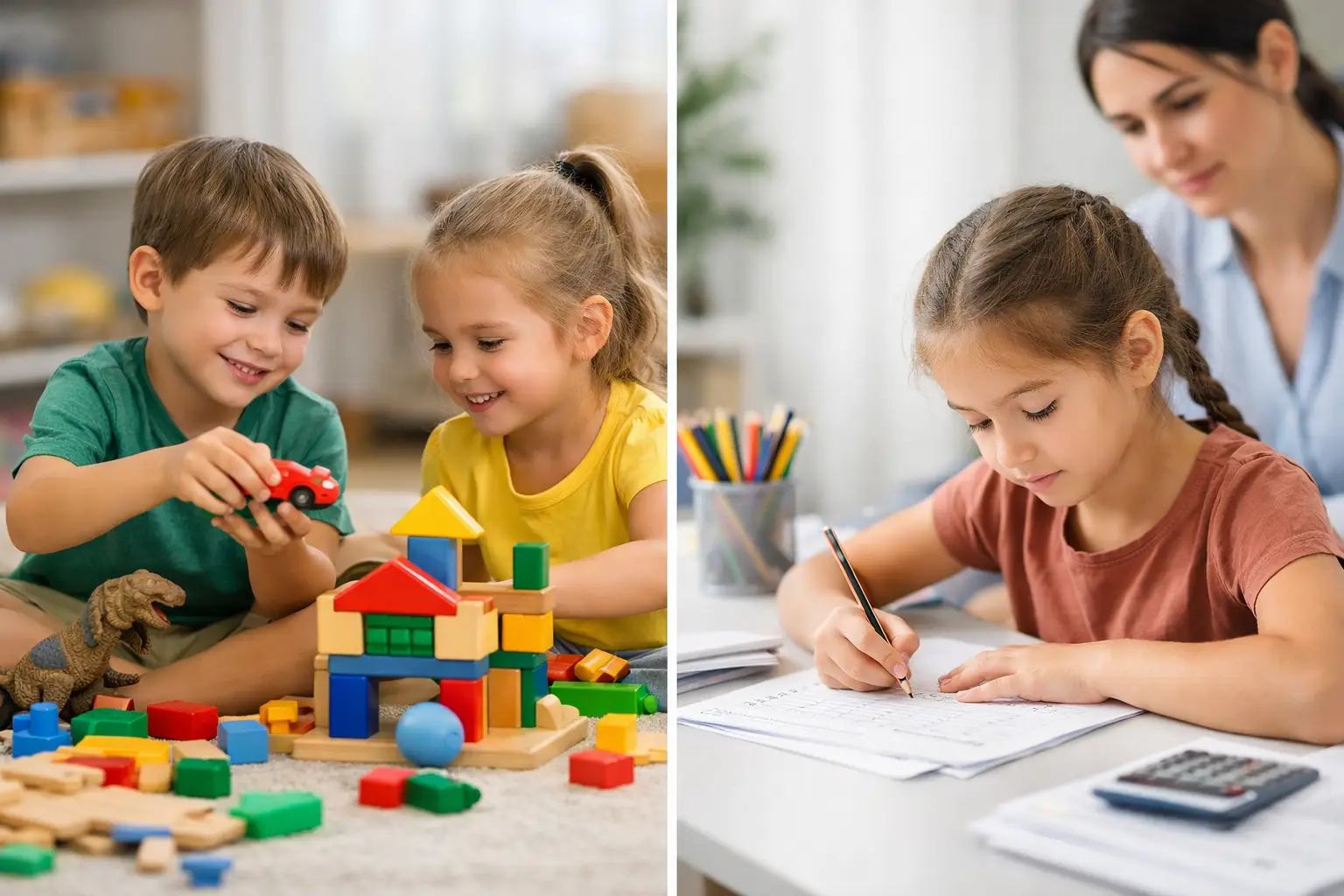
Play based learning versus worksheets affects confidence, skills, and school readiness. Learn how both can support your child at the right time each day.
A preschooler carefully sorting buttons by color, a toddler building a tall block tower, and a kindergartner acting out a grocery store are all learning moments. Yet many parents still wonder whether play based learning versus worksheets gives children the stronger start. The reassuring answer is not that children must choose one or the other. It is that the way a learning activity is offered matters just as much as the activity itself.
Children learn best when they feel safe to try, make mistakes, ask questions, and try again. Play creates those conditions naturally. Worksheets can have a useful place too, especially when they are brief, purposeful, and matched to a child’s developmental readiness. The goal is not more paper. It is meaningful growth.
Play is often mistaken for a break from learning. For young children, it is one of the primary ways learning happens. When children experiment, pretend, move, negotiate, and create, they are using developing skills in a real context instead of practicing them in isolation.
Consider a group of children building a ramp for toy cars. They may test which ramp is faster, adjust the height, count turns, describe what changed, and decide how to share materials. This one experience supports early math, science, language, problem-solving, motor coordination, and social skills. Just as importantly, it teaches a child that a first attempt does not have to be the final attempt.
That is the power of a growth mindset in action. A tower falls, so a child rebuilds it with a wider base. A puzzle feels tricky, so they rotate the piece and keep looking. With an encouraging teacher nearby, children begin to connect effort and strategy with progress. They learn, “I can’t do it yet,” rather than, “I can’t do it.”
Young children do not all develop on the same timetable. One child may recognize letters early but need more practice joining group play. Another may be a confident storyteller who is still developing hand strength for drawing and writing. Play gives educators opportunities to notice these differences and respond thoughtfully.
A teacher can extend a child’s interest in dinosaurs into vocabulary, counting, drawing, and dramatic play. For a child who needs support with communication, the teacher may model words during a favorite sensory activity or invite a peer into the play. This responsive approach respects each child’s starting point while still offering an appropriate next challenge.
The biggest difference is not simply that one involves toys and the other involves paper. It is the kind of thinking each approach invites.
A worksheet usually asks for one defined response. A child might trace the letter M, circle three apples, or match pictures that rhyme. These tasks can help a child practice a specific skill, especially if they already understand the concept and are ready to use a pencil. But a worksheet does not always show whether a child understands why an answer is correct. A child may copy, guess, or become discouraged by a task that asks more of their fine motor skills than their thinking skills.
Play offers more room for children to make choices, test ideas, and communicate their thinking. During a pretend restaurant game, children may write “orders,” count plates, compare quantities, use new words, and cooperate with friends. They are practicing many of the same early academic concepts, but the work has a purpose they can see and enjoy.
This does not mean worksheets are automatically harmful or that every child dislikes them. Some children genuinely enjoy completing a page, especially when it reflects something they already know. Older preschoolers and elementary-age children may benefit from occasional written practice as they build stamina and learn classroom routines. The concern comes when worksheets become the main measure of learning or replace the hands-on experiences children need.
Parents understandably want to know that their children will be ready for kindergarten and beyond. School readiness includes early literacy and math, but it is much broader than naming letters or completing a page independently.
A school-ready child is learning to listen and follow a routine, communicate needs, manage big feelings with support, take turns, persist with a challenge, and participate in a group. They are developing the confidence to raise a hand, ask a question, and recover when something feels hard. These abilities make academic instruction more accessible once children enter a more structured school setting.
Play supports these foundations every day. Board games build turn-taking and flexible thinking. Art activities strengthen the hands that will later hold pencils. Outdoor play develops coordination, risk assessment, and self-regulation. Dramatic play grows language and empathy as children practice seeing a situation from someone else’s point of view.
Worksheets may reinforce a skill, but they cannot fully recreate the social, emotional, and problem-solving learning that happens when children work alongside others. A child who can identify every letter but freezes when a peer takes a turn needs support that goes beyond a literacy page. Both needs matter.
The question is not, “Should children ever use worksheets?” A better question is, “What does this activity help my child practice, and is it the best way to practice it right now?”
A short worksheet can be useful after a hands-on experience. After reading a book about gardens and planting real seeds, a child might enjoy drawing what they think the plant will need to grow. After sorting buttons or snack crackers by color and size, an older preschooler might match a few picture patterns on paper. The worksheet becomes an extension of learning rather than the lesson itself.
It can also help children grow comfortable with tools they will use at school, such as crayons, pencils, scissors, and paper. The key is to keep expectations realistic. A young child who scribbles, uses an awkward grip, or loses interest quickly is not failing. They are showing us what skill is still developing.
If a worksheet leads to tears, avoidance, or repeated frustration, it is worth pausing. The child may need a more playful entry point, more physical movement, or a smaller next step. Forcing completion can teach children that learning is something to endure instead of something they can participate in.
You do not need a classroom full of materials to support learning through play. Daily routines offer rich opportunities for children to notice, practice, and contribute. Invite your child to count napkins for dinner, sort socks while folding laundry, help measure ingredients, retell part of a story, or make a sign for a pretend shop.
When your child is playing, try adding a gentle prompt instead of taking over. You might ask, “What do you think will happen if we add another block?” or “How could we make room for everyone?” Questions like these show children that their ideas matter. Give them enough wait time to think, even when their answer is unexpected.
For children who enjoy paper activities, keep them low-pressure and connected to their interests. A child who loves trucks might draw a road map. A child fascinated by space might label a made-up planet with the letters they know. Celebrate the effort behind the work: the careful marks, the willingness to try, the problem they solved. Correctness has a place, but encouragement keeps curiosity alive.
At Growth Mindset Learning Lab, we see learning as personal and active. Educators can observe a child during play, offer a well-timed challenge, and share meaningful progress with families. That partnership helps children receive consistent support across home and care settings, including when they need additional developmental resources.
A completed worksheet is easy to place on the refrigerator. Play can look messier because its learning is often happening in conversation, movement, experimentation, and repeated attempts. Still, parents can watch for powerful signs of growth: a child who stays with a puzzle longer, uses a new word, invites a friend to join, or proudly explains how they solved a problem.
Those moments are not extras beside learning. They are evidence that learning is taking root. Offer your child time to build, wonder, move, pretend, and begin again. The confidence they gain from being trusted in the process will travel with them far beyond the page.