Physical Address
381 Myrtle Avenue, Brooklyn, NY 11205
Physical Address
381 Myrtle Avenue, Brooklyn, NY 11205

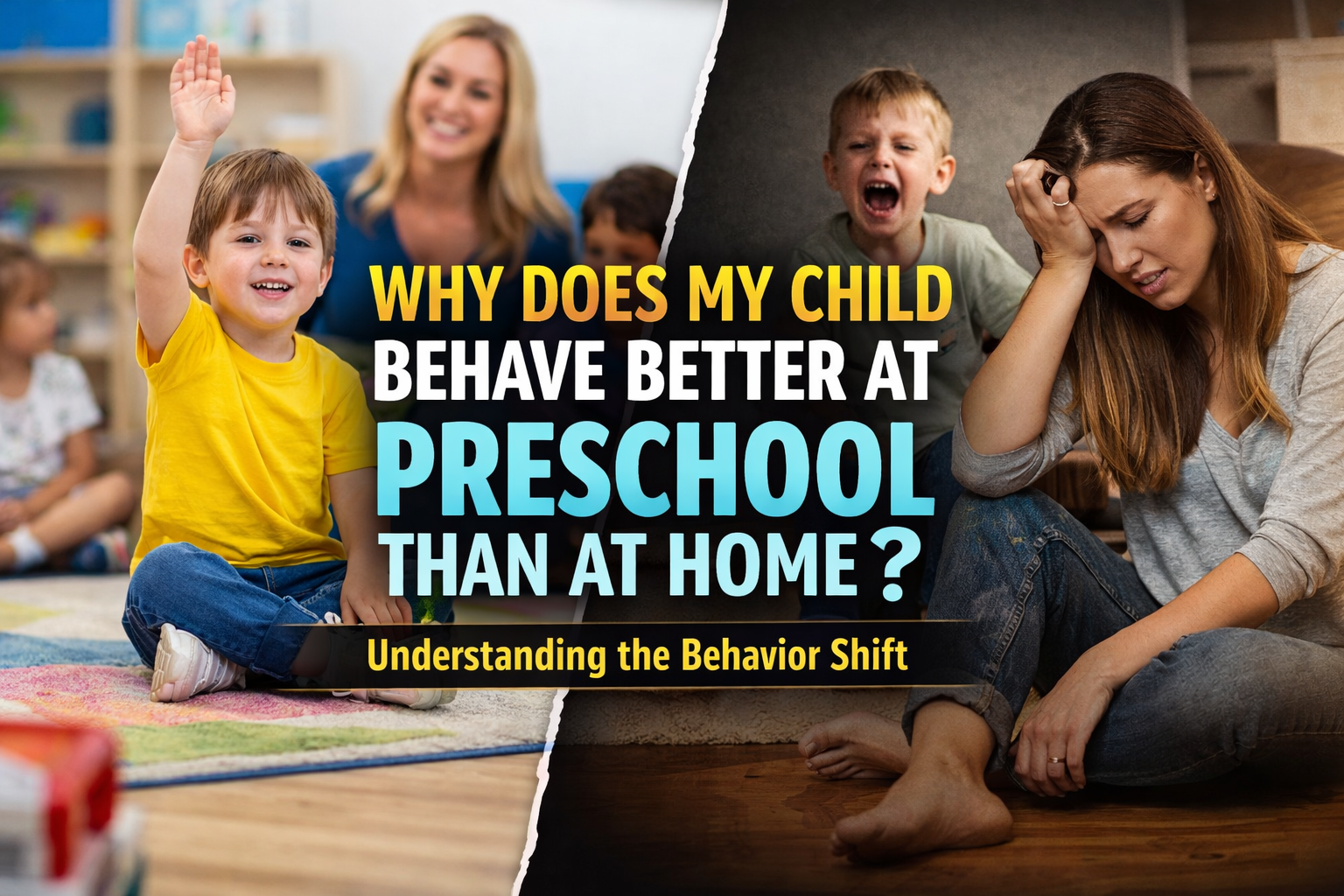
If you’ve ever thought, “Why does my child behave better at preschool than at home?” you are far from alone. Many parents are confused when their child is described as cooperative, polite, and attentive at school, yet seems irritable, defiant, or emotionally explosive at home.
Here is the direct answer: this pattern is common and developmentally normal. Children often use a tremendous amount of emotional and cognitive energy to stay regulated in structured environments like preschool. When they return home, they release that stored tension in the place where they feel safest.
This phenomenon is sometimes referred to as emotional decompression. It does not mean you are doing something wrong. In many cases, it actually reflects a secure attachment between you and your child.
Let’s break this down clearly and practically.
Preschool environments are carefully structured for regulation. Even if the day looks playful, it is built on predictable systems that help children function smoothly.
Preschools follow consistent schedules:
Circle time
Snack time
Outdoor play
Story time
Nap time
Predictable sequencing reduces anxiety and helps children anticipate what happens next.
In preschool, expectations are explicit:
Sit on the carpet
Raise your hand
Use quiet voices
Line up
Children understand the behavioral framework. When boundaries are consistent and reinforced the same way every day, many children rise to meet them.
In preschool classrooms, children often mirror group behavior. If most children are sitting quietly, your child is likely to follow. This is social learning in action.
The group dynamic naturally regulates behavior.
Teachers often prepare children before transitions:
“In five minutes we will clean up.”
“After snack, we go outside.”
This preparation reduces emotional shock.
Even toddlers are highly attuned to social belonging. At preschool, children want to fit in. They may suppress impulses in order to stay included.
Children often behave differently around non-parent authority figures. Teachers represent a different relational dynamic than parents. Many children instinctively maintain higher compliance in that setting.
So when your child seems perfect at school but not at home, it is often because preschool provides external regulation. Home requires more internal regulation and that is much harder for young children.
Now let’s talk about what happens after pickup.
You might notice:
Immediate whining
Sudden tears
Aggression toward siblings
Refusal to cooperate
Intense clinginess
This is what many parents describe as after preschool behavior changes.
Here is what is really happening.
Children tend to unravel where they feel safest.
Your child knows, even if they cannot articulate it, that your love is secure. They do not have to impress you or conform socially to stay connected.
That safety allows them to release stored emotions.
Preschool requires:
Social negotiation
Listening
Waiting
Sharing
Inhibition
That is a heavy load for a developing nervous system.
By the end of the day, children are often neurologically exhausted. Home becomes the place where their nervous system discharges that accumulated stress.
Self-regulation uses energy. Young children have limited reserves. When those reserves are depleted, behavior falls apart.
If your toddler acts out at home but not daycare, it may simply mean they have used up their emotional bandwidth.
Even positive stimulation can overwhelm:
Bright lights
Noise
Group instructions
Constant interaction
After hours of input, home can feel like the first opportunity to decompress.
Home is often more relaxed. Expectations vary. Parents multitask. Routines may be looser.
Without strong external scaffolding, a tired child struggles more.
So if your child behaves worse at home, it may actually reflect:
Secure attachment
Emotional safety
End-of-day depletion
Not parental failure.
Yes, in most cases.
Common signs of normal after-school decompression include:
Emotional meltdowns shortly after pickup
Increased clinginess
Irritability
Defiance over small requests
Temporary regression such as baby talk, accidents, or needing help with tasks
These behaviors typically:
Appear shortly after preschool begins
Improve over weekends
Gradually decrease as children build stamina
Many families notice this pattern most strongly in the first three to six months of preschool enrollment.
If your toddler is worse with you but relatively stable elsewhere, that often reflects emotional comfort rather than dysfunction.
While most cases are normal, it is important to stay observant.
Consider speaking with your child’s teacher or pediatrician if:
Behavior changes are extreme and persistent
Sleep is significantly disrupted
Appetite changes dramatically
School refusal escalates
Your child consistently expresses fear about school
There are reports of concerning peer interactions
The goal is not to assume a problem but to ensure your child feels safe and supported.
Balanced awareness is key.
Here is the empowering part. There are practical ways to ease after-school meltdowns.
For twenty to thirty minutes after pickup:
No demands
No rapid questions
Minimal stimulation
Offer a snack. Provide quiet play. Sit nearby.
Think of this as emotional recovery time.
Instead of correcting behavior immediately, prioritize connection.
Try:
A hug
Sitting together
Reading quietly
Gentle eye contact
Connection refills emotional reserves.
Instead of:
“What did you do?”
“Who did you play with?”
“Did you finish your lunch?”
Try:
“I’m happy to see you.”
Information can wait. Regulation comes first.
Consistent dinner, bath, and bedtime routines provide stability.
When a child’s nervous system is tired, predictability feels soothing.
Children borrow calm from adults.
If you feel overwhelmed by the meltdown, pause and breathe before responding. Your nervous system sets the tone for the room.
Open communication builds clarity and reassurance.
You might ask:
“Have you noticed signs of fatigue toward the end of the day?”
“How does my child handle transitions?”
“Are there particular times they seem overwhelmed?”
“Do you see any behaviors that concern you?”
Teachers can provide insight into patterns you cannot see at home.
Most often, you will hear that your child is managing well and simply decompressing later.
It is easy to assume that if your child behaves well at preschool but struggles at home, something is wrong with your parenting.
In reality, the opposite is often true.
Your child’s behavior at home is not proof that preschool is failing.
It often reflects emotional safety.
When children feel secure in their attachment, they allow themselves to release frustration, fatigue, and overstimulation in that safe space.
Over time, as regulation skills develop, the intensity of after-school meltdowns typically decreases.
This phase is part of learning how to manage a complex world.
If you are asking, “Why does my child behave better at preschool than at home?” the most reassuring truth may be this:
Children fall apart where they feel safe.
That safety is something you helped build.
Yes. Many children conserve emotional energy at school and release it at home. This is especially common in toddlers and preschoolers who are still developing self-regulation skills.
Toddlers often act out most around their primary attachment figure. They feel safest expressing big emotions with the person they trust most.
For many children, it improves within a few months as they build stamina for structured days. However, mild decompression behaviors can continue during developmental transitions.
Focus first on regulation and connection. Discipline is more effective when a child’s nervous system is calm. Address patterns thoughtfully rather than reacting to exhaustion-driven behavior.
Not necessarily. Some level of fatigue is normal in group environments. Concern arises only if your child shows persistent distress, fear, or extreme behavioral shifts.